
NHTSA ID Number: 10235845
Manufacturer Communication Number: 1113013R
Summary
Difficulty Starting, Rough Idle, Cam Position or Misfire DTCs
NUMBER: 11-130-13R
DATE: 04/05/13
REVISED: 01/28/14
| APPLICABILITY: | 2013MY Legacy and Outback 2.5L Models |
|---|---|
| 2012-13MY Impreza 2.0L Models | |
| 2013MY XV Crosstrek | |
| 2011-2014MY Forester | |
| 2013MY BRZ | |
| SUBJECT: | Difficulty Starting, Rough Idle, Cam Position or Misfire DTCs P0340, P0341, P0345, P0346, P0365, P0366, P0390, P0391, P0301, P0302, P0303 or P0304 |
INTRODUCTION
This Bulletin provides inspection and repair procedures for intake and exhaust camshaft position-related and/or engine misfire DTCs for the FA and FB engine-equipped models listed above. The camshaft position sensor (CPS) clearance may be out of specification causing these condition(s) and one or more of the DTCs listed above to set. In addition to a Check Engine light coming on, there may or may not be customer concerns of rough idle, extended cranking or no start.
NOTES:
- This Service Bulletin will replace Bulletin numbers 11-100-11R, 11-122-12, 11-124-12R and 11-125-12.
- Read this Bulletin completely before starting any repairs as service procedures have changed.
- An exhaust cam position sensor clearance out of specification will NOT cause a startability issue.
COUNTERMEASURE IN PRODUCTION
| MODEL | STARTING VIN |
| Legacy | D*038918 |
| Outback | D*295279 |
| Impreza 4-Door | D*020700 |
| Impreza 5-Door | D*835681 |
| XV Crosstrek | |
| Forester | E*410570 |
| BRZ | D*607924 |
NOTE: These VINs are for reference only. There may be a small number of vehicles after the starting VINs listed above which do not have the countermeasure due to production sequence changes.
PART INFORMATION
- Shim Kit, p.n. 10130AA060, contains 8 cam position sensor shims, 0.1 to 0.8mm in thickness.
- Shim Kit, p.n. 10130AA160, contains 8 cam position sensor shims (same thicknesses) to adjust the gap of the right-hand (Bank 1) exhaust camshaft position sensor on BRZ ONLY.
- Camshaft position sensor o-ring, p.n. 13099AA050 (one-time use item).
NOTE: The part numbers shown below are for reference only and cannot be ordered individually. If a shim is required, the corresponding shim kit must be ordered.
| PART NUMBER- R/H (B1) EXHAUST ONLY | PART NUMBER- INTAKE AND L/H (B2) EXHAUST ONLY | CLEARANCE (MM) | SHIM THICKNESS (MM) | TARGET GAP (MM) |
|---|---|---|---|---|
| 10130AA170 | 10130AA070 | 0.45 – 0.55 | 0.8 | 1.25 – 1.35 |
| 10130AA180 | 10130AA080 | 0.56 – 0.65 | 0.7 | 1.26 – 1.35 |
| 10130AA190 | 10130AA090 | 0.66 – 0.75 | 0.6 | 1.26 – 1.35 |
| 10130AA200 | 10130AA100 | 0.76 – 0.85 | 0.5 | 1.26 – 1.35 |
| 10130AA210 | 10130AA110 | 0.86 – 0.95 | 0.4 | 1.26 – 1.35 |
| 10130AA220 | 10130AA120 | 0.96 – 1.05 | 0.3 | 1.26 – 1.35 |
| 10130AA230 | 10130AA130 | 1.06 – 1.15 | 0.2 | 1.26 – 1.35 |
| 10130AA240 | 10130AA140 | 1.16 – 1.25 | 0.1 | 1.26 – 1.35 |
SPECIAL TOOLS
- Pulse/Analog Box, SDI Box and SSMIII
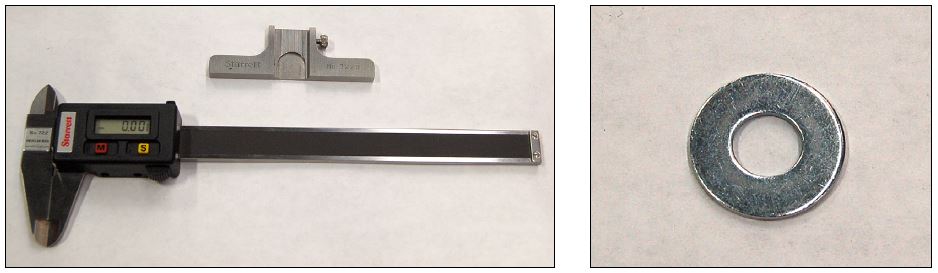
- Digital Caliper with depth attachment or 1” Depth Micrometer
- If you do not have a depth attachment or a 1” Depth Micrometer, use a flat washer, (outside diameter 25.5mm, inside diameter 11.1mm, 7.72mm thick) or equivalent. The purpose of the flat washer is to provide a surface for the caliper to rest on while making the sensor clearance measurements.
SERVICE PROCEDURE / INFORMATION
The Service Procedure of this Bulletin will have 2 sections, one for the intake cam position sensors and a second for the exhaust.
Check the waveforms of the applicable sensor (intake and / or exhaust) using the Pulse/ Analog Box, SDI Box and the oscilloscope function of the SSMIII. For detailed information and operating instructions, refer to the applicable Service Manual or the Subaru Diagnostic System (SDS) SSMIII User Guide. Click on “Help” at the top of the SSMIII Main Menu screen for the User Guide and additional helpful information.
When diagnosing an extended crank and / or a no start condition as outlined in this Bulletin, check the wave forms of the crank position and cam position sensors as follows:
- For FA and FB NA engines: Crank Position and Intake Cam Position (left & right)
- For FA Turbo engine: Crank Position along with Intake and Exhaust Cam Position (left & right)
IMPORTANT: When back-probing the ECM connectors to attach oscilloscope leads, refer to the wiring schematic for the specific DTC being diagnosed in the applicable Service Manual for proper connector and pin terminal locations.
Understanding the Relationships between the Crank and Camshaft Position Sensors
When setting up your oscilloscope to check Camshaft Position Sensor data, also select the Crankshaft Position Sensor data to help your understanding. It is important to arrange your selections in the order shown in the following screen shot examples. The Crank sensor data will make it easier to establish the firing order and identify cam sensor waveform inconsistencies. Example 1 on the next page is a perfectly normal pattern for all 3 sensors. Let’s look at some specifics of the data which will help you determine a “good” pattern versus a “bad” one.
Looking at the crank signal on page 4, you will see the difference between what we will call “1’s” (a single spike) and “2’s” (a double spike). This helps establish the engine’s firing order and what the corresponding cam sensor data should look like. The ECM looks for the “Edges” of the cam position sensor voltage drops to be within specified time “Window” parameters. The chart below Example 1 on the next page will help bring this all together. (Range was set to 250 msec / div. so the crank signal would be easier to understand here.)
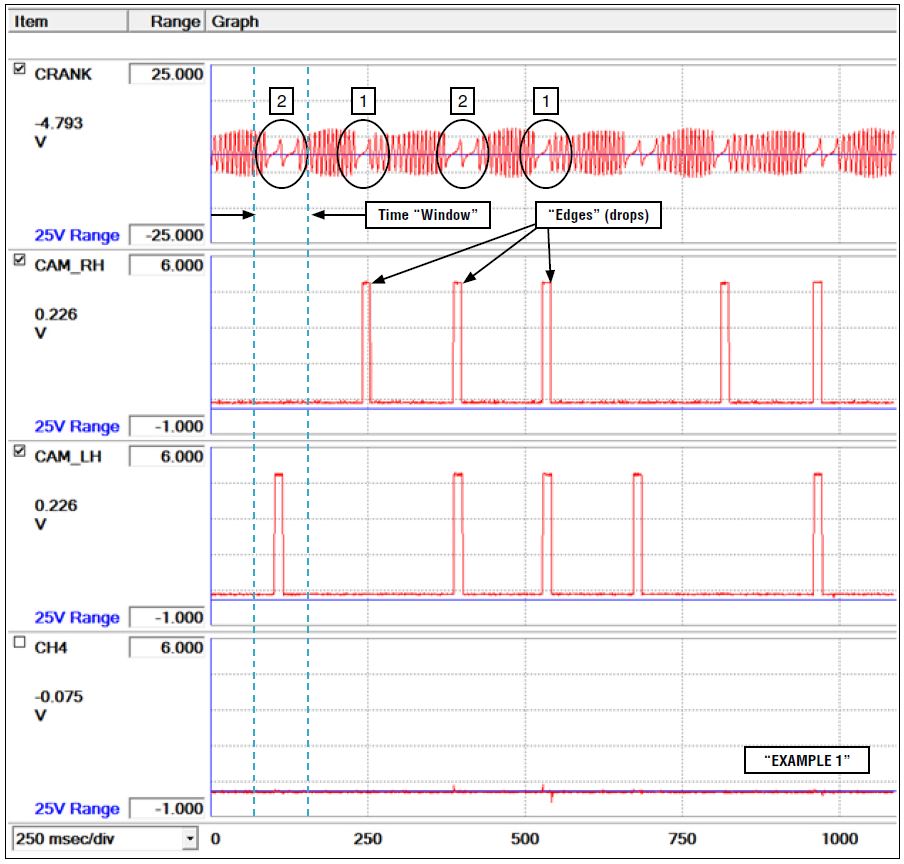
| Engine Firing Order | #1 | #3 | #2 | #4 |
| Crank Signal (“1” or “2”?) | “1” | “2” | “1” | “2” |
| Is Cam Signal Edge Within Window RH? | Yes | No | Yes | Yes |
| Is Cam Signal Edge Within Window LH? | Yes | Yes | No | Yes |
NOTE: A LH cam position sensor signal does not always indicate a corresponding #2 or #4 cylinder firing. (The same applies to the RH side.)
Using the chart above and comparing it to Example 1, it can be determined the first cylinder shown in the screen shot is #3 because the crank signal is a “2” and there is an edge signal within the window on the LH but not the RH cam sensor. Next cylinder in the firing order would be #2 as the crank position signal is a “1” and there is an edge signal in the window for the RH but not for the LH, and so on…
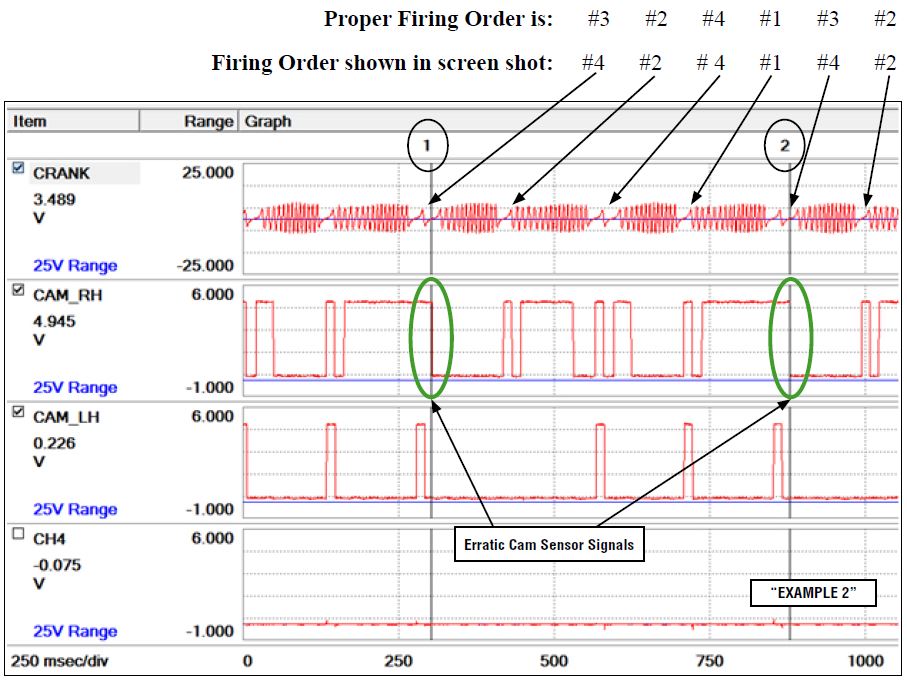
Example 2 below shows a “Bad” pattern for the RH cam sensor. Marks #1 and #2 show what appears to be #4 cylinder firing but, the next cylinder to fire according to the screen shot is #2 followed by #4 then #1. The pattern for the RH sensor never shows the proper sequence to fire #3 cylinder. In this case, recheck the data again after installing a .2mm shim under the RH cam sensor.
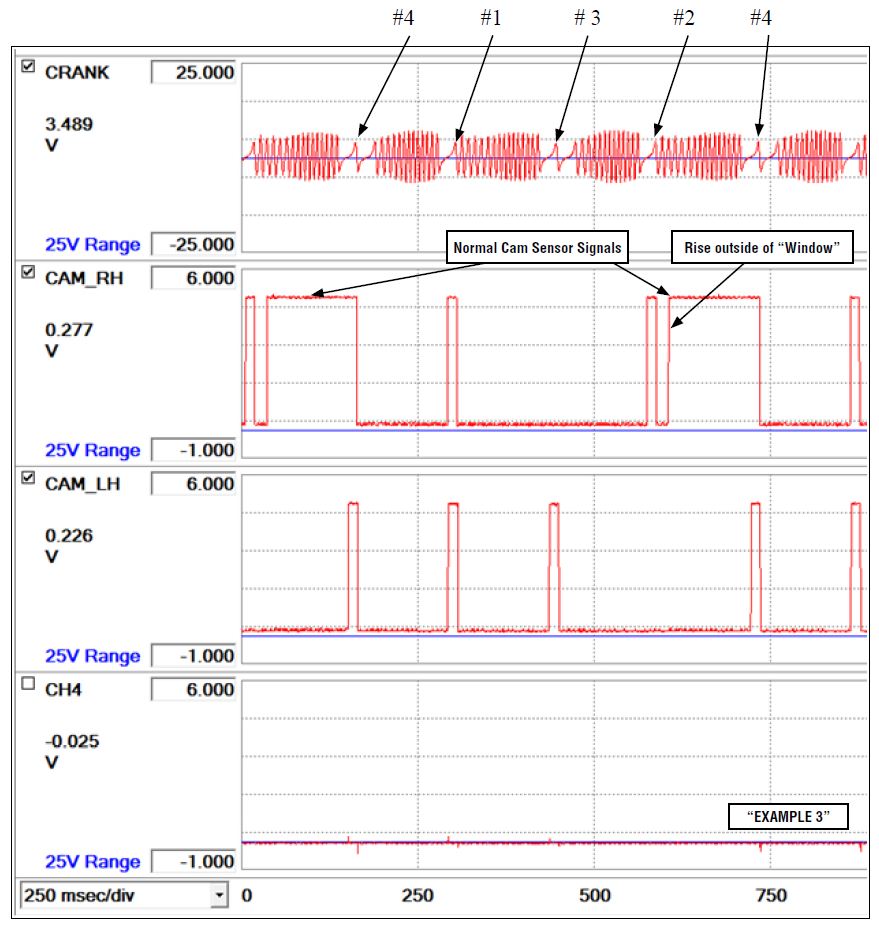
Example 3 shows what appears to be an erratic signal from the RH cam sensor but, you can see all the cam sensor data signal edges (drops) follow the chart and firing order as they are supposed to. Other signal edges (rises or drops) outside the “window” or a longer time line as shown here prior to the #4 signal edges seen on the RH cam sensor pattern are examples of signals which will be “ignored” by the ECM and are not a cause for concern.
IMPORTANT: If you confirm an irregular wave form pattern, BEFORE performing the measurement and shim selection procedures, install a .2mm shim under the suspect intake or exhaust camshaft position sensor. If there is no change, remove the .2mm shim and install a .4mm shim. USE ONLY ONE SHIM PER SENSOR, NO STACKING. If the wave pattern is lost, remove the .4mm shim and replace with a .3mm shim. Recheck the pattern and if it appears normal, complete the repair as shown below. If an abnormal pattern persists, proceed with the rest of the clearance measurement and shim selection procedures.
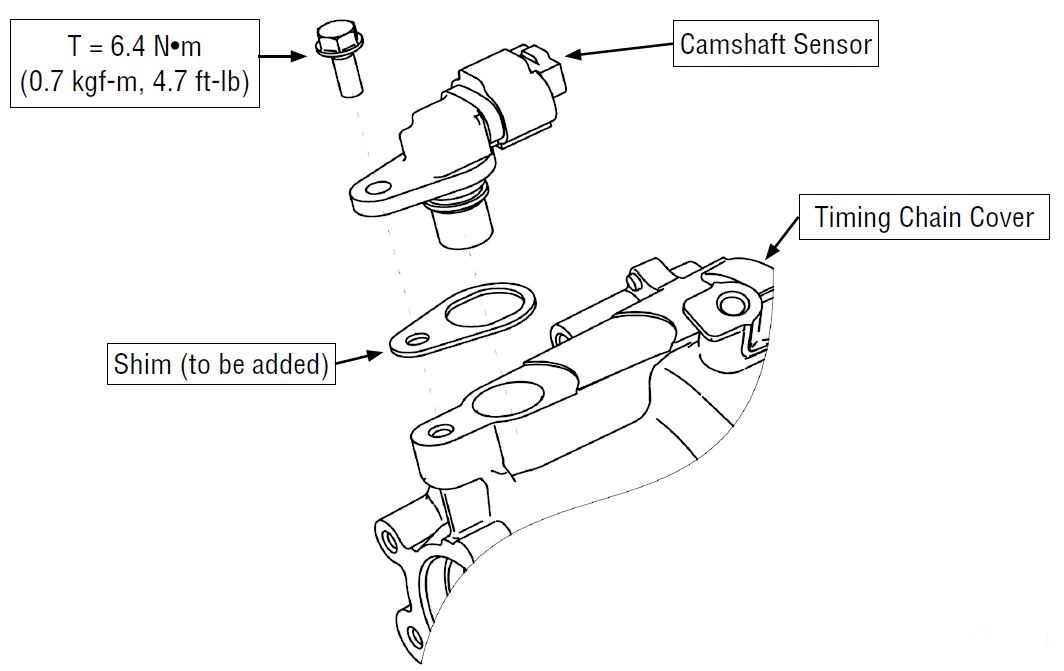
- Install a NEW camshaft position sensor o-ring (one-time use item).
- Reinstall the camshaft position sensor and shim.
- Torque the sensor retaining bolt to 6.4 Nm (4.7 ft. lbs. or 56.4 inch-pounds).
- Reconnect the sensor engine wiring harness connector.
- Reconnect the negative battery cable then reset the radio station presets (and navigation system favorites if applicable) to complete the repair.
If an abnormal oscilloscope pattern persists for an intake sensor, measure the clearance between the end of the camshaft position sensor and the sensor plate using the following procedure. If a suspect pattern is verified for an exhaust sensor, a revised procedure will be outlined later in this Bulletin. If the pattern is normal, refer to the applicable Service Manual for additional troubleshooting and diagnostic procedures for the stored DTCs.
MEASUREMENT AND SHIM SELECTION PROCEDURES
The specified clearance is 1.3 +/- .05mm (1.25 to 1.35mm or .049” to .053”).
- Record the customer’s radio station presets (and navigation system favorites if applicable).
- Disconnect the negative battery cable.
- Remove the camshaft position sensor from the timing chain cover using the procedure in the applicable Service Manual.
A = Top of timing chain cover to camshaft position sensor plate
B = Camshaft position sensor mating surface to the bottom of the sensor
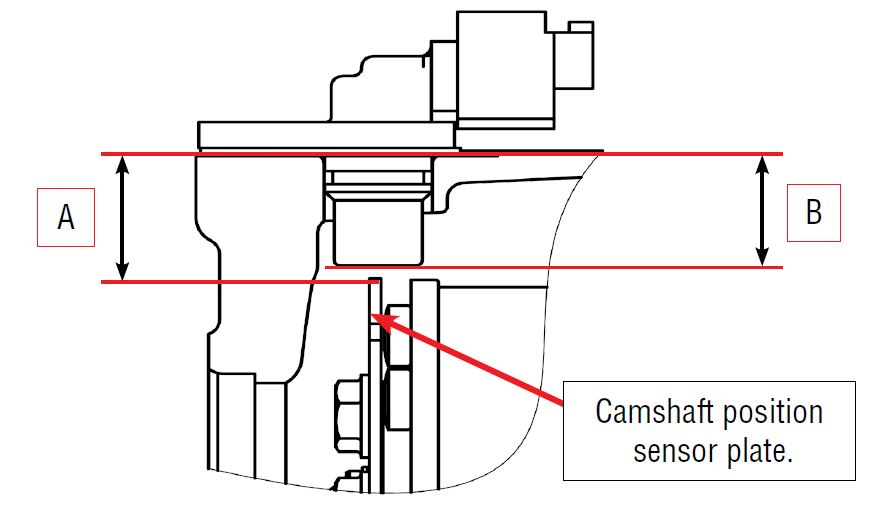
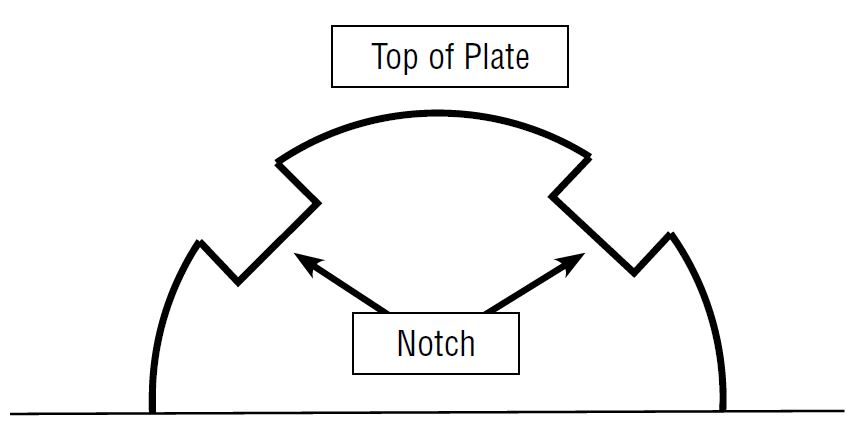
NOTE: When measuring “A”, make sure you are measuring to the outside diameter or “top” of the sensor plate and not to the bottom of a notch as shown below. Be sure to record all measurements.
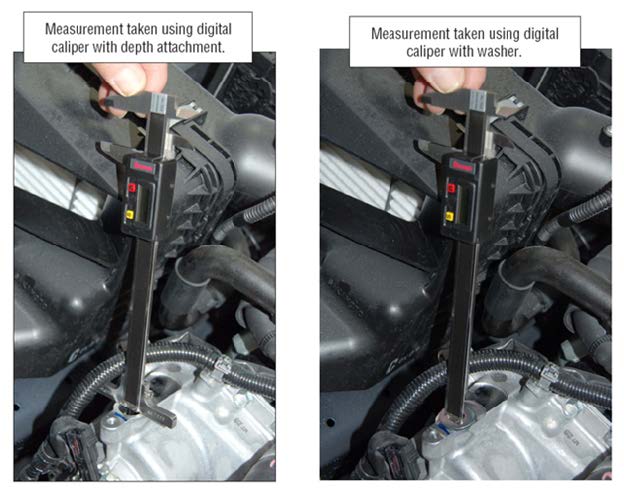
IMPORTANT: When using the flat washer, make sure the washer is fully seated on the machined surfaces of the timing cover or your measurements will not be accurate.
- Take a measurement and record the reading.
- Using a breaker bar and 22mm socket, place the socket on the crankshaft pulley bolt and rotate the engine clockwise approximately 70°. CAUTION: Do not rotate the engine counter-clockwise, doing so will loosen the crankshaft pulley bolt. If the engine is accidently turned counter-clockwise make sure the bolt is re-torqued following the proper procedure in the applicable Service Manual.
- Take a measurement and record the reading.
- Rotate the engine clockwise approximately 70°.
- Take a measurement and record the reading.
- Use the smallest of the three measurements and record the result.
When taking measurement “B”, use a flat steel ruler or equivalent along with the digital caliper.
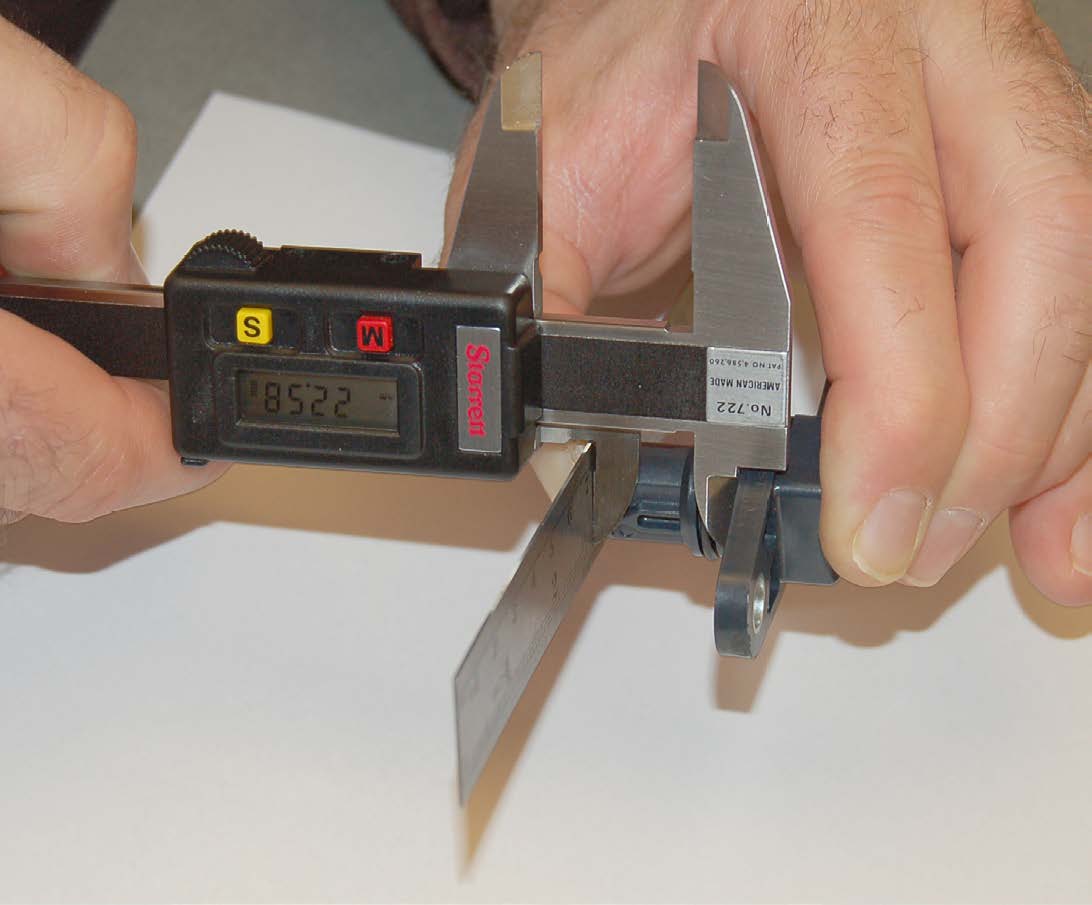
- Measure the distance between the camshaft position sensor mounting surface and the bottom of the sensor as shown above.
IMPORTANT: Be sure to account for the thickness of the flat washer (if you are using one) when performing your calculations to determine the required shim thickness.
The specified clearance is 1.3 +/- .05mm (1.25 to 1.35mm or .049” to .053”).
Example calculation
(the 1.72mm thickness of the flat washer is subtracted from “A” dimension)
A = Top of timing chain cover to camshaft position sensor plate
B = Camshaft position sensor mating surface to the bottom of the sensor
A) 25.42 – 1.72 = 23.70
A = 23.70
B = 22.58
A – B = 1.12 (clearance)
In this example a 0.2 shim is required.
| Clearance (mm) | Shim Thickness (mm) | Target Gap (mm) |
| 1.06 – 1.15 | 0.2 | 1.26 – 1.35 |
- After the correct shim is selected and a normal oscilloscope pattern has been verified:
a. Install a NEW camshaft position sensor o-ring (one-time use item).
b. Reinstall the camshaft position sensor and shim.
c. Torque the sensor retaining bolt to 6.4 Nm (4.7 ft. lbs. or 56.4 inch-pounds).
d. Reconnect the sensor engine wiring harness connector.
e. Reconnect the negative battery cable then reset the radio station presets (and navigation system favorites if applicable) to complete the repair.
BRZ EXHAUST CAMSHAFT POSITION SENSOR PROCEDURE
In the event you have a DTC stored for an exhaust camshaft position sensor, the repair procedure has been revised. Due to the position of the right-hand (Bank 1) sensor, measurement of the gap without removing the front catalyst is extremely difficult as shown in the photo below.
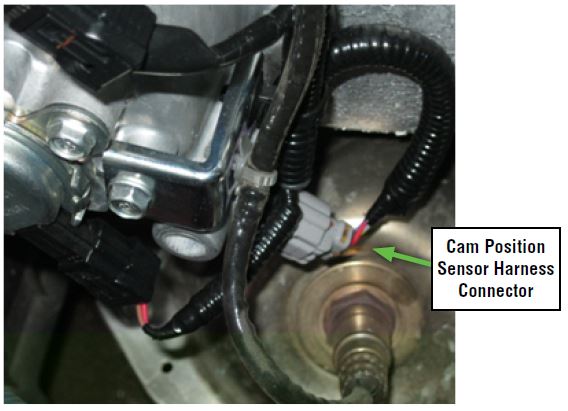
In addition, the engine under-guards must be removed along with the plastic splash shield to access the left-hand (Bank 2) sensor. As a solution, the following procedure has been developed:
- Confirm the irregular oscilloscope pattern for the corresponding DTC stored.
- Remove the sensor from the timing cover and install a .2mm thick shim from the applicable kit.
- Reinstall the sensor, torque the sensor retaining bolt to 6.4 Nm (4.7 ft. lbs. or 56.4 inch-pounds) then recheck the oscilloscope pattern.
If the pattern is normal, the repair is complete. If the irregular pattern persists, repeat Steps 2 and 3 after removing the .2mm shim and installing a .3 mm thick shim. ONE SHIM ONLY, NO STACKING. Repeat as necessary increasing the shim thickness .1 mm at a time until a normal scope pattern can be verified.
- After the correct shim is selected:
a. Install a new camshaft position sensor o-ring (one-time use item).
b. Reinstall the camshaft position sensor and shim.
c. Torque the sensor retaining bolt to 6.4 Nm (4.7 ft. lbs. or 56.4 inch-pounds).
d. Reconnect the sensor engine wiring harness connector.
e. Reconnect the negative battery cable and reset the radio station presets (and navigation system favorites if applicable) to complete the repair.
- Be sure to clear the ECM memory before returning the vehicle to the customer.
10 Affected Products
Vehicles
| MAKE | MODEL | YEAR |
| SUBARU | BRZ | 2013 |
| SUBARU | CROSSTREK | 2013 |
| SUBARU | FORESTER | 2011-2014 |
| SUBARU | IMPREZA | 2013 |
| SUBARU | LEGACY | 2013 |
| SUBARU | OUTBACK | 2013 |
| SUBARU | XV CROSSTREK | 2013 |
1 Associated Document
Manufacturer Communications
NUMBER: 11-130-13R
DATE: 04/05/13
REVISED: 01/28/14
MC-10235845-9999.pdf 4134.542KB
NHTSA ID Number: 10052498
Manufacturer Communication Number: TSB-11-130-13R
Summary
SUBARU: SOME VEHICLES MAY EXPERIENCE DIFFICULTY STARTING, ROUGH IDLE, CAM POSITION OR MISFIRE DTCS. THIS BULLETIN CONTAINS THE INSPECTION AND REPAIR. *JS UPDATED 11/18/14. *PE
2 Associated Documents
Service Bulletin Document
NUMBER: 11-130-13R
DATE: 04/05/13
REVISED: 06/19/13
SB-10052498-5734.pdf 1161.665KB
Service Bulletin Document
NUMBER: 11-130-13R
DATE: 04/05/13
REVISED: 01/28/14
SB-10052498-4477.pdf 771.668KB
NHTSA ID Number: 10232512
Manufacturer Communication Number: 1113013R
Summary
Difficulty Starting, Rough Idle, Cam Position or Misfire DTCs
1 Associated Document
Manufacturer Communications
NUMBER: 11-130-13R
DATE: 04/05/13
REVISED: 06/19/13
MC-10232512-9999.pdf 2689.504KB
NHTSA ID Number: 10233120
Manufacturer Communication Number: 1113013
Summary
Difficulty Starting, Rough Idle, Cam Position or Misfire DTCs
1 Associated Document
Manufacturer Communications
NUMBER: 11-130-13
DATE: 04/05/13
MC-10233120-9999.pdf 1822.559KB
NHTSA ID Number: 10234273
Manufacturer Communication Number: 1112512
Summary
Misfire DTCs
1 Associated Document
Manufacturer Communications
NUMBER: 11-125-12
DATE: 12/03/12
MC-10234273-9999.pdf 1691.723KB
NHTSA ID Number: 10234272
Manufacturer Communication Number: 1112412R
Summary
Difficulty Starting, Rough Idle, Cam Position
1 Associated Document
Manufacturer Communications
NUMBER: 11-124-12R
DATE: 11/12/12
REVISED: 11/27/12
MC-10234272-9999.pdf 954.614KB
NHTSA ID Number: 10234270
Manufacturer Communication Number: 1112212
Summary
Difficulty Starting, Rough Idle
1 Associated Document
Manufacturer Communications
NUMBER: 11-122-12
DATE: 11/02/12
MC-10234270-9999.pdf 947.164KB
NHTSA ID Number: 10234268
Manufacturer Communication Number: 1110011R
Summary
Difficulty Starting, Rough Idle
1 Associated Document
Manufacturer Communications
NUMBER: 11-100-11R
DATE: 05/20/11
REVISED: 11/27/12
MC-10234268-9999.pdf 3459.151KB
NHTSA ID Number: 10235844
Manufacturer Communication Number: 1110011R
Summary
Difficulty Starting, Rough Idle
1 Associated Document
Manufacturer Communications
NUMBER: 11-100-11R
DATE: 05/20/11
REVISED: 01/17/12
MC-10235844-9999.pdf 3153.229KB

- OE-Level diagnostics on your smart device
- FREE Software updates - No subscriptions, no fees – EVER
- Full bi-directional control, live actuation test
- Supports 23 vehicle reset/relearn functions, including throttle matching, ABS bleeding, TPMS reset, etc.
- Live data mapping and freeze frame capturing


- CEL Doctor: The ANCEL AD310 is one of the best-selling OBD II scanners on the market and is recommended by Scotty Kilmer, a YouTuber and auto mechanic. It can easily determine the cause of the check engine light coming on. After repairing the vehicle's problems, it can quickly read and clear diagnostic trouble codes of emission system, read live data & hard memory data, view freeze frame, I/M monitor readiness and collect vehicle information
- Sturdy and Compact: Equipped with a 2.5 foot cable made of very thick, flexible insulation. It is important to have a sturdy scanner as it can easily fall to the ground when working in a car. The AD310 OBD2 scanner is a well-constructed mechanic tool with a sleek design. It weighs 12 ounces and measures 8.9 x 6.9 x 1.4 inches. Thanks to its compact design and light weight, transporting the device is not a problem. The buttons are clearly labelled and the screen is large and displays results clearly
- Accurate Fast and Easy to Use: The AD310 scanner can help you or your mechanic understand if your car is in good condition, provides exceptionally accurate and fast results, reads and clears engine trouble emission codes in seconds after you fixed the problem. This device will let you know immediately and fix the problem right away without any car knowledge. No need for batteries or a charger, get power directly from the OBDII Data Link Connector in your vehicle
- OBDII Protocols and Car Compatibility: Many cheap scan tools do not really support all OBD2 protocols. AD310 scanner as it can support all OBDII protocols such as KWP2000, J1850 VPW, ISO9141, J1850 PWM and CAN. This device also has extensive vehicle compatibility with 1996 US-based, 2000 EU-based and Asian cars, light trucks, SUVs, as well as newer OBD2 and CAN vehicles both domestic and foreign. Pls confirm with our customer service whether it is compatible with your vehicle before purchasing
- Home Necessity and Worthy to Own: This is an excellent code reader to travel or home with as it weighs less and it is compact in design. You can easily slide it in your backpack as you head to the garage, or put it on the dashboard, this will be a great fit for you. The AD310 is not only portable, but also accurate and fast in performance. Moreover, it covers various car brands and is suitable for people who just need a code reader to check their car

- MAINTAIN PEAK PERFORMANCE AND SAFETY ON THE ROAD - Easily find and fix the problem with your vehicle using the INNOVA 5610 bidirectional scan tool. This OBD2 scanner diagnostic tool provides real-time solutions to troubleshoot issues. Access OBD2 and OEM live data with ease, making it an essential car scanner diagnostic tool. Perfect for those seeking reliable car diagnostic scanner and code readers & scan tools for vehicles.
- PRO-LEVEL FUNCTIONALITIES - Use the INNOVA 5610’s Enhanced Data Stream to view live data for advanced systems like ABS, SRS, transmission, and engine. The Special Reset Function lets you use dealership-level re-learn procedures. This car diagnostic scanner is ideal for those needing a bidirectional scan tool or mechanic tools automotive for professional repairs. Compatible with select vehicle makes and models; not universal.
- COMMAND WITH BIDIRECTIONAL CONTROLS - The INNOVA 5610 bidirectional scan tool sends commands to test functions such as fuel pump on/off or retracting the electronic parking brake. With this car scanner diagnostic for all cars, you can operate like a pro. Ideal for those seeking a car code reader and reset tool or advanced fixd car diagnostic tool capabilities. Compatible with select vehicle makes and models; not universal.
- EASY TO USE - The INNOVA 5610 OBD2 scanner diagnostic tool supports English, Spanish, and French. Easily use this scanner for car on most 1996 - 2023 (2024 coming soon) OBD2 vehicles to verify repairs. Designed for ease of operation, it’s a dependable code reader for cars and trucks and check engine code reader. To confirm vehicle coverage, please utilize Innova's Coverage Checker.
- BUY AND DRIVE WITH CONFIDENCE - Backed by ASE-Certified support, this car scanner pairs with the RepairSolutions2 app, trusted by 4M users, for wireless OBD scanner functionality. With free updates and no subscription fees, this durable car computer diagnostic reader ensures you’re prepared for any repair. A must-have diagnostic scanner for vehicles.

- 2026 Advanced ECU Coding Scan Tool: Maximize the capabilities of your vehicles with the ArtiDiag Pro. This scan tool, seamlessly compatible with renowned models such as VW, A-U-D-I, SKODA, SEAT, BENZ, and more, empowers you to uncover hidden features, deactivate annoying functions, and code retrofitted components for peak performance. Ensure a backup before coding and steer clear of problems on low battery levels.
- Efficient Diagnostics with Bidirectional Control: Say goodbye to uncertainty, streamline diagnostics, and reclaim valuable time with ArtiDiag Pro scan tool. This bidirectional scan tool exceeds expectations, enabling targeted tests on individual actuators to swiftly identify and resolve issues. Covering lights, door locks, fuel and coolant systems, windows, wipers, EVAP, and more in vehicle components.
- 35+ Services Resolve 90% of Repair Challenges: Unleash maximum productivity with the ArtiDiag Pro, a scan tool that tackles 90% of maintenance issues through its 35 special functions. Effortlessly clear oil maintenance indicators with oil reset. Engage the EPB Reset for brake system management and establish precise alignment with the Steering Angle Reset to define the straight-line reference position for your vehicle.
- FCA Autoauth : This diagnostic tool supports Autoauth for FCA SGW/Renault, Chrysler, Jeep, Dodge, Fiat etc. 2017 and later. NOTE: Due to Product Upgrade, there is no Chrysler 12+8 adapter, the BMW-20 Adapter in the package any more. We are sincerely sorry for the inconvenience. NOTE: Please confirm compatibility before purchase.(Topdon Website>Support>Vehicle Coverage)
- Professional Customer Support: At TOPDON, your satisfaction is our unwavering commitment. Experience hassle-free support and a lifetime of expert assistance. Should you encounter any challenges, reach out to us at 833-629-4832. For returns, please damage the packaging to prevent Amazon from reselling it. Please be advised that after two years, a subscription fee of 249 Bucks will apply.
- [Diagnose Like a Pro] BlueDriver Pro Next-Gen is a professional OBD2 scanner and diagnostic tool that helps you scan, understand, and clear vehicle trouble codes with confidence. Turn your phone into a powerful car diagnostic scanner—no guesswork, no unnecessary repairs.
- [Read and Clear More Codes Than Ever] Read and clear more codes than basic car code readers. Access enhanced diagnostics for Check Engine, ABS, SRS, Airbag, TPMS, Transmission, and more on supported vehicles, including expanded coverage on newer model years.
- [Verified Fixes and Real-Time Data] Get unlimited, technician-verified repair reports matched to your VIN, with definitions, causes, and confirmed fixes. Monitor live vehicle data as you drive, view freeze frames, check smog readiness, and analyze Mode 6 test results.
- [Expanded Make & Model Coverage] Optimized for today’s vehicles with strong support for GM, Ford, Stellantis (RAM, Jeep, Chrysler), Toyota, Honda, Nissan, Mazda, Subaru, Hyundai, Mercedes-Benz, BMW, and VW. Enhanced communication on select 2024+ Nissan and Mazda models (see compatibility chart).
- [Gas Vehicles 1996+ & Select Light-Duty Trucks] Works with all gas-powered vehicles made in 1996 or newer, plus select light-duty trucks and diesels, including F-250, RAM 2500, Silverado, and Sierra. Built for daily drivers, family vehicles, and real-world truck use.
SEOCONTENT-START
Bulletin Number: 11-130-13R; Date: 01/31/14 Page 1 NUMBER: 11-130-13R DATE: 04/05/13 REVISED: 01/28/14 APPLICABILITY: 2013MY Legacy and Outback 2.5L Models 2012-13MY Impreza 2.0L Models 2013MY XV Crosstrek 2011-2014MY Forester 2013MY BRZ SUBJECT: Difficulty Starting, Rough Idle, Cam Position or Misfire DTCs P0340, P0341, P0345, P0346, P0365, P0366, P0390, P0391, P0301, P0302, P0303 or P0304 INTRODUCTION This Bulletin provides inspection and repair procedures for intake and exhaust camshaft position-related and/or engine misfire DTCs for the FA and FB engine-equipped models listed above. The camshaft position sensor (CPS) clearance may be out of specification causing these condition(s) and one or more of the DTCs listed above to set. In addition to a Check Engine light coming on, there may or may not be customer concerns of rough idle, extended cranking or no start. NOTES: • This Service Bulletin will replace Bulletin numbers 11-100-11R, 11-122-12, 11-124-12R and 11-125-12. • Read this Bulletin completely before starting any repairs as service procedures have changed. • An exhaust cam position sensor clearance out of specification will NOT cause a startability issue. COUNTERMEASURE IN PRODUCTION MODEL STARTING VIN Legacy D*038918 Outback D*295279 Impreza 4-Door D*020700 Impreza 5-Door D*835681 XV Crosstrek Forester E*410570 BRZ D*607924 NOTE: These VINs are for reference only. There may be a small number of vehicles after the starting VINs listed above which do not have the countermeasure due to production sequence changes. CAUTION: VEHICLE SERVICING PERFORMED BY UNTRAINED PERSONS COULD RESULT IN SERIOUS INJURY TO THOSE PERSONS OR TO OTHERS. Subaru Service Bulletins are intended for use by professional technicians ONLY. They are written to inform those technicians of conditions that may occur in some vehicles, or to provide information that could assist in the proper servicing of the vehicle. Properly trained technicians have the equipment, tools, safety instructions, and know-how to do the job correctly and safely. If a condition is described, DO NOT assume that this Service Bulletin applies to your vehicle, or that your vehicle will have that condition. SUBARU OF AMERICA, INC. IS “ISO 14001 COMPLIANT” The international standard for excellence in Environmental Management Systems. Please recycle or dispose of automotive products in a manner that is friendly to our environment and in accordance with all local, state and federal laws and regulations. SERVICE BULLETIN ATTENTION: GENERAL MANAGER q PARTS MANAGER q CLAIMS PERSONNEL q SERVICE MANAGER q IMPORTANT – All Service Personnel Should Read and Initial in the boxes provided, right. continued… Bulletin Number: 11-130-13R; Date: 01/31/14 Page 2 PART INFORMATION • Shim Kit, p.n. 10130AA060, contains 8 cam position sensor shims, 0.1 to 0.8mm in thickness. • Shim Kit, p.n. 10130AA160, contains 8 cam position sensor shims (same thicknesses) to adjust the gap of the right-hand (Bank 1) exhaust camshaft position sensor on BRZ ONLY. • Camshaft position sensor o-ring, p.n. 13099AA050 (one-time use item). NOTE: The part numbers shown below are for reference only and cannot be ordered individually. If a shim is required, the corresponding shim kit must be ordered. PART NUMBERR/ H (B1) EXHAUST ONLY PART NUMBERINTAKE AND L/H (B2) EXHAUST ONLY CLEARANCE (MM) SHIM THICKNESS (MM) TARGET GAP (MM) 10130AA170 10130AA070 0.45 – 0.55 0.8 1.25 – 1.35 10130AA180 10130AA080 0.56 – 0.65 0.7 1.26 – 1.35 10130AA190 10130AA090 0.66 – 0.75 0.6 1.26 – 1.35 10130AA200 10130AA100 0.76 – 0.85 0.5 1.26 – 1.35 10130AA210 10130AA110 0.86 – 0.95 0.4 1.26 – 1.35 10130AA220 10130AA120 0.96 – 1.05 0.3 1.26 – 1.35 10130AA230 10130AA130 1.06 – 1.15 0.2 1.26 – 1.35 10130AA240 10130AA140 1.16 – 1.25 0.1 1.26 – 1.35 SPECIAL TOOLS • Pulse/Analog Box, SDI Box and SSMIII • Digital Caliper with depth attachment or 1” Depth Micrometer • If you do not have a depth attachment or a 1” Depth Micrometer, use a flat washer, (outside diameter 25.5mm, inside diameter 11.1mm, 7.72mm thick) or equivalent. The purpose of the flat washer is to provide a surface for the caliper to rest on while making the sensor clearance measurements. Digital Caliper with Depth Attachment continued… Bulletin Number: 11-130-13R; Date: 01/31/14 Page 3 SERVICE PROCEDURE / INFORMATION The Service Procedure of this Bulletin will have 2 sections, one for the intake cam position sensors and a second for the exhaust. Check the waveforms of the applicable sensor (intake and / or exhaust) using the Pulse/ Analog Box, SDI Box and the oscilloscope function of the SSMIII. For detailed information and operating instructions, refer to the applicable Service Manual or the Subaru Diagnostic System (SDS) SSMIII User Guide. Click on “Help” at the top of the SSMIII Main Menu screen for the User Guide and additional helpful information. When diagnosing an extended crank and / or a no start condition as outlined in this Bulletin, check the wave forms of the crank position and cam position sensors as follows: • For FA and FB NA engines: Crank Position and Intake Cam Position (left & right) • For FA Turbo engine: Crank Position along with Intake and Exhaust Cam Position (left & right) IMPORTANT: When back-probing the ECM connectors to attach oscilloscope leads, refer to the wiring schematic for the specific DTC being diagnosed in the applicable Service Manual for proper connector and pin terminal locations. Understanding the Relationships between the Crank and Camshaft Position Sensors When setting up your oscilloscope to check Camshaft Position Sensor data, also select the Crankshaft Position Sensor data to help your understanding. It is important to arrange your selections in the order shown in the following screen shot examples. The Crank sensor data will make it easier to establish the firing order and identify cam sensor waveform inconsistencies. Example 1 on the next page is a perfectly normal pattern for all 3 sensors. Let’s look at some specifics of the data which will help you determine a “good” pattern versus a “bad” one. Looking at the crank signal on page 4, you will see the difference between what we will call “1’s” (a single spike) and “2’s” (a double spike). This helps establish the engine’s firing order and what the corresponding cam sensor data should look like. The ECM looks for the “Edges” of the cam position sensor voltage drops to be within specified time “Window” parameters. The chart below Example 1 on the next page will help bring this all together. (Range was set to 250 msec / div. so the crank signal would be easier to understand here.) continued… Bulletin Number: 11-130-13R; Date: 01/31/14 Page 4 Engine Firing Order #1 #3 #2 #4 Crank Signal (“1” or “2”?) “1” “2” “1” “2” Is Cam Signal Edge Within Window RH? Yes No Yes Yes Is Cam Signal Edge Within Window LH? Yes Yes No Yes NOTE: A LH cam position sensor signal does not always indicate a corresponding #2 or #4 cylinder firing. (The same applies to the RH side.) Using the chart above and comparing it to Example 1, it can be determined the first cylinder shown in the screen shot is #3 because the crank signal is a “2” and there is an edge signal within the window on the LH but not the RH cam sensor. Next cylinder in the firing order would be #2 as the crank position signal is a “1” and there is an edge signal in the window for the RH but not for the LH, and so on… continued… 2 1 2 1 Time “Window” “Edges” (drops) “EXAMPLE 1” Bulletin Number: 11-130-13R; Date: 01/31/14 Page 5 Example 2 below shows a “Bad” pattern for the RH cam sensor. Marks #1 and #2 show what appears to be #4 cylinder firing but, the next cylinder to fire according to the screen shot is #2 followed by #4 then #1. The pattern for the RH sensor never shows the proper sequence to fire #3 cylinder. In this case, recheck the data again after installing a .2mm shim under the RH cam sensor. Proper Firing Order is: #3 #2 #4 #1 #3 #2 Firing Order shown in screen shot: #4 #2 # 4 #1 #4 #2 continued… Erratic Cam Sensor Signals “EXAMPLE 2” Bulletin Number: 11-130-13R; Date: 01/31/14 Page 6 Example 3 shows what appears to be an erratic signal from the RH cam sensor but, you can see all the cam sensor data signal edges (drops) follow the chart and firing order as they are supposed to. Other signal edges (rises or drops) outside the “window” or a longer time line as shown here prior to the #4 signal edges seen on the RH cam sensor pattern are examples of signals which will be “ignored” by the ECM and are not a cause for concern. #4 #1 # 3 #2 #4 continued… Normal Cam Sensor Signals Rise outside of “Window” “EXAMPLE 3” Bulletin Number: 11-130-13R; Date: 01/31/14 Page 7 IMPORTANT: If you confirm an irregular wave form pattern, BEFORE performing the measurement and shim selection procedures, install a .2mm shim under the suspect intake or exhaust camshaft position sensor. If there is no change, remove the .2mm shim and install a .4mm shim. USE ONLY ONE SHIM PER SENSOR, NO STACKING. If the wave pattern is lost, remove the .4mm shim and replace with a .3mm shim. Recheck the pattern and if it appears normal, complete the repair as shown below. If an abnormal pattern persists, proceed with the rest of the clearance measurement and shim selection procedures. a. Install a NEW camshaft position sensor o-ring (one-time use item). b. Reinstall the camshaft position sensor and shim. c. Torque the sensor retaining bolt to 6.4 Nm (4.7 ft. lbs. or 56.4 inch-pounds). d. Reconnect the sensor engine wiring harness connector. e. Reconnect the negative battery cable then reset the radio station presets (and navigation system favorites if applicable) to complete the repair. If an abnormal oscilloscope pattern persists for an intake sensor, measure the clearance between the end of the camshaft position sensor and the sensor plate using the following procedure. If a suspect pattern is verified for an exhaust sensor, a revised procedure will be outlined later in this Bulletin. If the pattern is normal, refer to the applicable Service Manual for additional troubleshooting and diagnostic procedures for the stored DTCs. MEASUREMENT AND SHIM SELECTION PROCEDURES The specified clearance is 1.3 +/- .05mm (1.25 to 1.35mm or .049” to .053”). 1. Record the customer’s radio station presets (and navigation system favorites if applicable). 2. Disconnect the negative battery cable. 3. Remove the camshaft position sensor from the timing chain cover using the procedure in the applicable Service Manual. continued… T = 6.4 N•m (0.7 kgf-m, 4.7 ft-lb) Camshaft Sensor Timing Chain Cover Shim (to be added) Bulletin Number: 11-130-13R; Date: 01/31/14 Page 8 A = Top of timing chain cover to camshaft position sensor plate B = Camshaft position sensor mating surface to the bottom of the sensor A B Camshaft position sensor plate. NOTE: When measuring “A”, make sure you are measuring to the outside diameter or “top” of the sensor plate and not to the bottom of a notch as shown below. Be sure to record all measurements. Top of Plate Notch continued… Bulletin Number: 11-130-13R; Date: 01/31/14 Page 9 IMPORTANT: When using the flat washer, make sure the washer is fully seated on the machined surfaces of the timing cover or your measurements will not be accurate. 1. Take a measurement and record the reading. 2. Using a breaker bar and 22mm socket, place the socket on the crankshaft pulley bolt and rotate the engine clockwise approximately 70°. CAUTION: Do not rotate the engine counter-clockwise, doing so will loosen the crankshaft pulley bolt. If the engine is accidently turned counter-clockwise make sure the bolt is re-torqued following the proper procedure in the applicable Service Manual. 3. Take a measurement and record the reading. 4. Rotate the engine clockwise approximately 70°. 5. Take a measurement and record the reading. 6. Use the smallest of the three measurements and record the result. Measurement taken using digital caliper with depth attachment. Measurement taken using digital caliper with washer. continued… Bulletin Number: 11-130-13R; Date: 01/31/14 Page 10 When taking measurement “B”, use a flat steel ruler or equivalent along with the digital caliper. 7. Measure the distance between the camshaft position sensor mounting surface and the bottom of the sensor as shown above. IMPORTANT: Be sure to account for the thickness of the flat washer (if you are using one) when performing your calculations to determine the required shim thickness. The specified clearance is 1.3 +/- .05mm (1.25 to 1.35mm or .049” to .053”). Example calculation (the 1.72mm thickness of the flat washer is subtracted from “A” dimension) A = Top of timing chain cover to camshaft position sensor plate B = Camshaft position sensor mating surface to the bottom of the sensor A) 25.42 – 1.72 = 23.70 A = 23.70 B = 22.58 A – B = 1.12 (clearance) In this example a 0.2 shim is required. Clearance (mm) Shim Thickness (mm) Target Gap (mm) 1.06 – 1.15 0.2 1.26 – 1.35 continued… Bulletin Number: 11-130-13R; Date: 01/31/14 Page 11 8. After the correct shim is selected and a normal oscilloscope pattern has been verified: a. Install a NEW camshaft position sensor o-ring (one-time use item). b. Reinstall the camshaft position sensor and shim. c. Torque the sensor retaining bolt to 6.4 Nm (4.7 ft. lbs. or 56.4 inch-pounds). d. Reconnect the sensor engine wiring harness connector. e. Reconnect the negative battery cable then reset the radio station presets (and navigation system favorites if applicable) to complete the repair. BRZ EXHAUST CAMSHAFT POSITION SENSOR PROCEDURE In the event you have a DTC stored for an exhaust camshaft position sensor, the repair procedure has been revised. Due to the position of the right-hand (Bank 1) sensor, measurement of the gap without removing the front catalyst is extremely difficult as shown in the photo below. In addition, the engine under-guards must be removed along with the plastic splash shield to access the left-hand (Bank 2) sensor. As a solution, the following procedure has been developed: 1. Confirm the irregular oscilloscope pattern for the corresponding DTC stored. 2. Remove the sensor from the timing cover and install a .2mm thick shim from the applicable kit. 3. Reinstall the sensor, torque the sensor retaining bolt to 6.4 Nm (4.7 ft. lbs. or 56.4 inch-pounds) then recheck the oscilloscope pattern. Cam Position Sensor Harness Connector continued… Bulletin Number: 11-130-13R; Date: 01/31/14 Page 12 If the pattern is normal, the repair is complete. If the irregular pattern persists, repeat Steps 2 and 3 after removing the .2mm shim and installing a .3 mm thick shim. ONE SHIM ONLY, NO STACKING. Repeat as necessary increasing the shim thickness .1 mm at a time until a normal scope pattern can be verified. 4. After the correct shim is selected: a. Install a new camshaft position sensor o-ring (one-time use item). b. Reinstall the camshaft position sensor and shim. c. Torque the sensor retaining bolt to 6.4 Nm (4.7 ft. lbs. or 56.4 inch-pounds). d. Reconnect the sensor engine wiring harness connector. e. Reconnect the negative battery cable and reset the radio station presets (and navigation system favorites if applicable) to complete the repair. 5. Be sure to clear the ECM memory before returning the vehicle to the customer. WARRANTY/CLAIM INFORMATION For vehicles within the Basic New Car Limited Warranty period, this repair may be claimed using the following information: NOTE: Operation Numbers A817-213 and A817-214 are only applicable to 2.0L Impreza, XV Crosstrek, BRZ and 2014 Forester Turbo models (models equipped with exhaust AVCS). Labor Description Labor Operation# Fail Code Labor Time Intake Cam Sensor Measurement and Shim Installation A817-211 UKM-20 0.5 Exhaust Cam Sensor Measurement and Shim Installation A817-213 0.6 One Intake and one Exhaust Cam Sensor Measurement and Shim Installation A817-214 1.0
SEOCONTENT-END
This product presentation was made with AAWP plugin.