NHTSA ID Number: 10219476
Manufacturer Communication Number: Subaru Tech Tips
Summary
Special Edition, 2012 current model subaru evaporative diagnostics and smoke testing.
SPECIAL EDITION
2012-Current Model Subaru Evaporative Diagnostics & Smoke Testing
When faced with an Evaporative Emissions DTC (P0441-P0459, P2404 etc.), the first thing most Technicians do is reach for the smoke machine to check for leaks.
This should no longer be a Technicians first step for diagnosis.
Never put pressure into the ELCM or use smoke as residual oil in the smoke can contaminate the ELCM and cause internal components to malfunction.
Instead, the first step for diagnosis should be a forced self-test of the evaporative emission system, recording the test results, then graphing the test to determine where the problem is.
Late model Subaru vehicles are equipped with an Electronic Leak Check Module (ELCM) in their evaporative system. The ELCM is a very sensitive and delicate piece of electronic equipment that has the capability of performing self-tests to inspect the systems integrity for leaks and operation. These systems operate on vacuum, not pressure, when performing their self-test.
Follow the outlined directions in this document for performing the ELCM forced self-test, then use the diagnosis procedure found in STIS to identify where the problem is. Technicians can graph the recorded self test and compare it to the diagnosis chart. This chart is in the General Description tab or located at the bottom of most Evap DTC Trouble Trees in STIS. This article also includes a reference chart, along with examples of completed graphs with a set DTC. The Subaru smoke machine tool kit comes with the correct quick disconnect plugs to be able to block off the disconnected lines. Below are step-by-step directions for performing the ELCM force test, saving that test data and using it to diagnose the concern.
NOTE: For diagnosing Evaporative codes on 2011-2014 models, the following testing may not apply. Please see TechTIPS from 3/17 and / or 10/19 for performing this testing.
NOTE: This testing does not work on STI models. Always follow the testing methods outlined in the Service Manual for STI models
113 Affected Products
Vehicles
| MAKE | MODEL | YEAR |
| SUBARU | ASCENT | 2019-2022 |
| SUBARU | BRZ | 2013-2022 |
| SUBARU | CROSSTREK | 2012-2022 |
| SUBARU | CROSSTREK HYBRID | 2016-2022 |
| SUBARU | FORESTER | 2012-2022 |
| SUBARU | IMPREZA | 2012-2022 |
| SUBARU | IMPREZA WRX | 2015 |
| SUBARU | LEGACY | 2012-2022 |
| SUBARU | LEVORG | 2022 |
| SUBARU | OUTBACK | 2012-2022 |
| SUBARU | SOLTERRA | 2023 |
| SUBARU | TRIBECA | 2012-2014 |
| SUBARU | WRX | 2012-2022 |
| SUBARU | WRX STI | 2012-2022 |
| SUBARU | XV CROSSTREK | 2012-2017, 2022 |
| SUBARU | XV CROSSTREK HYBRID | 2014-2015 |
1 Associated Document
Manufacturer Communications
TIPS_SE_July2022 – TechTIPS NewsLetter – 2012-Current Model Subaru Evaporative Diagnostics & Smoke Testing
MC-10219476-0001.pdf 3790.348KB

- HyperSmoke Technology – Creates Thick Visible Smoke for Easy Leak Testing. Adjustable Pressure. Infinite Smoke. Instant Warmup. Built-In Air Compressor Motor. OEM Approved Smoke Fluid. Designed and Engineered by AutoLine Pro USA, an American Team of Individuals bringing the latest innovation to you.
- HyperSmoke Benefits – Hypersmoke never overheats, has EVAP mode to protect EVAP from permanent damage, has a mode with higher pressure to test for more leaks like boost/turbo, has a built-in air compressor, comes with proper automotive-grade leak detection fluid for safe and accurate testing, engineered in the USA with custom components and is a professional-grade tool made for serious diagnostic work.
- Includes Everything You Need – Made for ALL Leak Testing Scenarios - EVAP, Vacuum, Intake, Exhaust, Turbo, Superchargers, EGR, Cooling Systems, Engine Blocks, Oil Leaks, Body Work, Wind & Water Leaks, worn rubber, gaskets, seals, connectors, Cars, Trucks, Tractors, Semis, Motorcycles, Scientific Apparatus, and more!
- OEM Approved Smoke Fluid Included – Safe for all systems and sensors. Premium High-Smoke output formula. We’ve included plenty of fluid so you can focus on what’s important – 240 minutes of runtime!
- Adjustable Pressure – Adjustable Pressure gives you the flexibility to leak test a significantly wider array of systems ranging from EVAP all the way to Turbocharged systems. Why is this feature important? EVAP must be tested at under 1 PSI otherwise DAMAGE WILL OCCUR. This is a feature MISSING from other overseas copy-paste smoke machines.

- HyperSmoke Technology – Creates Thick Visible Smoke for Easy Leak Testing. Adjustable Pressure. Infinite Smoke. Instant Warmup. Built-In Air Compressor Motor. OEM Approved Smoke Fluid. Designed and Engineered by AutoLine Pro USA, an American Team of Individuals bringing the latest innovation to you.
- HyperSmoke Benefits – Hypersmoke never overheats, has EVAP mode to protect EVAP from permanent damage, has a mode with higher pressure to test for more leaks like boost/turbo, has a built-in air compressor, comes with proper automotive-grade leak detection fluid for safe and accurate testing, engineered in the USA with custom components and is a professional-grade tool made for serious diagnostic work.
- Includes Everything You Need – Made for ALL Leak Testing Scenarios - EVAP, Vacuum, Intake, Exhaust, Turbo, Superchargers, EGR, Cooling Systems, Engine Blocks, Oil Leaks, Body Work, Wind & Water Leaks, worn rubber, gaskets, seals, connectors, Cars, Trucks, Tractors, Semis, Motorcycles, Scientific Apparatus, and more!
- OEM Approved Smoke Fluid Included – Safe for all systems and sensors. Premium High-Smoke output formula. We’ve included plenty of fluid so you can focus on what’s important – 240 minutes of runtime!
- Adjustable Pressure – Adjustable Pressure gives you the flexibility to leak test a significantly wider array of systems ranging from EVAP all the way to Turbocharged systems. Why is this feature important? EVAP must be tested at under 1 PSI otherwise DAMAGE WILL OCCUR. This is a feature MISSING from other overseas copy-paste smoke machines.

- HyperSmoke Technology – Creates Thick Visible Smoke for Easy Leak Testing. Adjustable Pressure. Infinite Smoke. Instant Warmup. Built-In Air Compressor Motor. OEM Approved Smoke Fluid. Designed and Engineered by AutoLine Pro USA, an American Team of Individuals bringing the latest innovation to you.
- HyperSmoke Benefits – Hypersmoke never overheats, has EVAP mode to protect EVAP from permanent damage, has a mode with higher pressure to test for more leaks like boost/turbo, has a built-in air compressor, comes with proper automotive-grade leak detection fluid for safe and accurate testing, engineered in the USA with custom components and is a professional-grade tool made for serious diagnostic work.
- Includes Everything You Need – Made for ALL Leak Testing Scenarios - EVAP, Vacuum, Intake, Exhaust, Turbo, Superchargers, EGR, Cooling Systems, Engine Blocks, Oil Leaks, Body Work, Wind & Water Leaks, worn rubber, gaskets, seals, connectors, Cars, Trucks, Tractors, Semis, Motorcycles, Scientific Apparatus, and more!
- OEM Approved Smoke Fluid Included – Safe for all systems and sensors. Premium High-Smoke output formula. We’ve included plenty of fluid so you can focus on what’s important – 240 minutes of runtime!
- Adjustable Pressure – Adjustable Pressure gives you the flexibility to leak test a significantly wider array of systems ranging from EVAP all the way to Turbocharged systems. Why is this feature important? EVAP must be tested at under 1 PSI otherwise DAMAGE WILL OCCUR. This is a feature MISSING from other overseas copy-paste smoke machines.

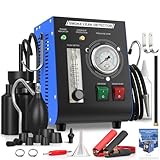
- [Built-in Air Pump]: Smoke machine features a built-in air pump, eliminating the need for an external air source, allowing you to perform tests anytime, anywhere. Simply add about 20ml of baby oil or Glycerin (oil not included) to start your testing effortlessly
- [Multi-Function]: Suitable for a wide range of tests, including EVAP systems, vacuum leaks, low-pressure turbo leaks, intake manifolds, cooling/EGR/exhaust systems, and more. It can be used on cars, motorcycles, and various other vehicles
- [Quick Detection]: The machine generates thick smoke within just 10 seconds of startup, providing enough output to detect even the smallest leaks, ensuring fast and accurate problem identification
- [Lightweight and Portable]: Weighing only 4.4lb, the Solary automotive smoke machine is compact, easy to store, and transport, making it an essential tool for every car owner
- [User-Friendly]: With a simple and intuitive interface, the device has a low entry barrier, making it easy for even first-time users to quickly get started
SEOCONTENT-START
Subaru Service and Technical Support Line Newsletter The Subaru TechTIPS newsletter is intended for use by professional Technicians ONLY. Articles are written to inform those Technicians of conditions that may occur in some vehicles, or to provide information that could assist in the proper servicing of the vehicle. Properly trained Technicians have the equipment, tools, safety instructions, and know-how to do the job correctly and safely. If a condition is described, DO NOT assume that your vehicle has or will have that condition. Impreza, Legacy, Justy, Loyale, Outback, Forester, Subaru SVX, WRX, WRX STI, Baja, Tribeca, BRZ, XV Crosstrek and “Quality Driven” are Registered Trademarks. ISO 14001 is the international standard for excellence in Environmental Management Systems. Please recycle or dispose of automotive products in a manner that is friendly to our environment and in accordance with all local, state and federal laws and regulations. CAUTION: VEHICLE SERVICING PERFORMED BY UNTRAINED PERSONS COULD RESULT IN SERIOUS INJURY TO THOSE PERSONS OR TO OTHERS. SUBARU OF AMERICA, INC. IS ISO 14001 COMPLIANT = When faced with an Evaporative Emissions DTC (P0441-P0459, P2404 etc.), the first thing most Technicians do is reach for the smoke machine to check for leaks. This should no longer be a Technicians first step for diagnosis. Never put pressure into the ELCM or use smoke as residual oil in the smoke can contaminate the ELCM and cause internal components to malfunction. Instead, the first step for diagnosis should be a forced self-test of the evaporative emission system, recording the test results, then graphing the test to determine where the problem is. Late model Subaru vehicles are equipped with an Electronic Leak Check Module (ELCM) in their evaporative system. The ELCM is a very sensitive and delicate piece of electronic equipment that has the capability of performing self-tests to inspect the systems integrity for leaks and operation. These systems operate on vacuum, not pressure, when performing their self-test. ©2022 Subaru of America, Inc. All rights reserved. CONTINUED ON THE NEXT PAGE home SPECIAL EDITION 2012-Current Model Subaru Evaporative Diagnostics & Smoke Testing Special Edition TechTIPS Page 1 of 14 Follow the outlined directions in this document for performing the ELCM forced self-test, then use the diagnosis procedure found in STIS to identify where the problem is. Technicians can graph the recorded self test and compare it to the diagnosis chart. This chart is in the General Description tab or located at the bottom of most Evap DTC Trouble Trees in STIS. This article also includes a reference chart, along with examples of completed graphs with a set DTC. The Subaru smoke machine tool kit comes with the correct quick disconnect plugs to be able to block off the disconnected lines. Below are step-by-step directions for performing the ELCM force test, saving that test data and using it to diagnose the concern. NOTE: For diagnosing Evaporative codes on 2011-2014 models, the following testing may not apply. Please see TechTIPS from 3/17 and / or 10/19 for performing this testing. NOTE: This testing does not work on STI models. Always follow the testing methods outlined in the Service Manual for STI models. 2013MY to Current Legacy and Outback 2012MY to Current Impreza 2013MY to Current XV Crosstrek 2014MY to Current Forester 2013MY-2014MY Tribeca 2015MY to Current WRX 2013MY to Current BRZ 2019MY to Current Ascent OVERVIEW OF EVAPORATIVE SYSTEM • The ELCM is a device installed in the evaporative system to detect leaks and blockages. • According to legal regulations, leaks of 0.02 inch or more need to be detectable. The main components in the EVAP system: CPC valve (purge control solenoid) ELCM Canister Fuel tank Drain filter CONTINUED ON THE NEXT PAGE Special Edition TechTIPS Page 2 of 14 OVERVIEW OF EVAPORATIVE SYSTEM (CONTINUED) Solenoid valve for purge control SUMMARY OF EVAP LEAK DIAGNOSIS • EVAP Leak diagnosis is conducted during soak (5~7h after engine stop). • The ELCM draws a vacuum in the Evaporative line and determines the leak by the level of negative pressure. To find a 0.02-inch leak, the ELCM measures two types of pressure: 1) Reference pressure: pressure at the occurrence of a 0.02-inch leak 2) Tank pressure: pressure in the EVAP line While measuring pressures 1) and 2), a P code is established according to the location of the abnormality. CONTINUED ON THE NEXT PAGE Special Edition TechTIPS Page 3 of 14 SUMMARY OF EVAP LEAK DIAGNOSIS (CONTINUED) The conditions needed to perform the test are as follows: Vehicle Model Year Engine Coolant Temperature Engine Oil Temp Intake Air Temp Battery Voltage F° F° F° F° V Impreza/ Crosstrek 13MY – 22MY ≥ 40 < 113 ≥ 40 ≥ 40 ≥ 10.9 Outback/ Legacy 15MY – 22MY ≥ 40 < 113 ≥ 40 ≥ 40 ≥ 10.9 Forester 14MY – 22MY ≥ 40 < 113 ≥ 40 ≥ 40 ≥ 10.9 Ascent ALL ≥ 40 < 113 ≥ 40 ≥ 40 ≥ 10.9 WRX 15MY – 22MY ≥ 40 < 113 ≥ 40 ≥ 40 ≥ 10.9 BRZ 13MY – 20MY ≥ 40 < 113 ≥ 40 ≥ 40 ≥ 10.9 22MY ≥ 40 < 95 ≥ 40 ≥ 40 ≥ 10.9 Tribeca 13MY-14MY ≥ 40 < 113 ≥ 40 ≥ 40 ≥ 10.9 NOTE: There is no fuel level standard for test conditions other than the tank cannot be full. The IGN must be ON with the engine OFF when performing the test. The self-test will take 15-30 minutes. Using the DCA-8000 in power supply mode is always recommended. CAUTION: Test results may be unstable or inaccurate when fuel levels are 100%. From the SSM4 Menu: This test is performed with the engine stopped and IGNITION-ON. Select Diagnosis (Not Generic OBDII) Choose the appropriate vehicle info. XNO CONTINUED ON THE NEXT PAGE Special Edition TechTIPS Page 4 of 14 SUMMARY OF EVAP LEAK DIAGNOSIS (CONTINUED) Select Each System Select Engine X NO Select Work Support (Not Active Test) Select Evaporative System Leak Test CONTINUED ON THE NEXT PAGE Special Edition TechTIPS Page 5 of 14 CONTINUED ON THE NEXT PAGE SUMMARY OF EVAP LEAK DIAGNOSIS (CONTINUED) After being asked about the execution conditions, memory clearing conditions, etc., press “Start” to start Leak Test. *Avoid using the test immediately after refueling or when the battery voltage is low, as this may cause false readings. After the parameters have been met and the test is started, the SSM will indicate the test is “Running”. After confirmation that the test is running, select Combo Graph. This will allow observation of the test in real time. Special Edition TechTIPS Page 6 of 14 CONTINUED ON THE NEXT PAGE SUMMARY OF EVAP LEAK DIAGNOSIS (CONTINUED) Change the items to be displayed • Evap System Absolute Pressure • ELCM switching valve • ELCM pump Change time scale from “1” to “60”. Click to adjust value scale Choose Evap System Absolute Pressure. Select Manual range. Adjust Max: 43.5000 psi to 15.0000 psi Adjust Min: 0 psi 13.5000 psi Special Edition TechTIPS Page 7 of 14 CONTINUED ON THE NEXT PAGE SUMMARY OF EVAP LEAK DIAGNOSIS (CONTINUED) Technicians will now be able to watch the test as it is being performed. As the test runs, it will perform different phases. Phase Explaination of Phase Phase A The ECM uses this phase to check the operation of the vacuum pump. The ECM simulates a 0.02 leak by using the reference pressure as the vacuum pump is running. The switching valve is in the ‘open’ position. This allows ambient air to enter the ELCM. Phase B The ECM measures the pressure and calculates the limit of negative pressure based on the reference. Phase C The switching valve closes, and ECM measures the evaporative side pressure. The jump in pressure is caused by the movement of the switching valve. This also seals the system from ambient air. Phase D With the switching valve closed, the ECM measures the pressure in the EVAP system in relation to the amount of time it takes to reach maximum vacuum. Phase E The ECM measures the reference pressure again with the 0.02 simulated leak (ELCM orifice). During this phase, the ECM is determining the size of any leaks. Pressure during this phase is compared to pressure during phase B and should be very similar. Special Edition TechTIPS Page 8 of 14 CONTINUED ON THE NEXT PAGE SUMMARY OF EVAP LEAK DIAGNOSIS (CONTINUED) PhaseZ PhaseA PhaseB PhaseB PhaseC PhaseD The test can take 15-30 minutes to complete. Once the test has completed, the SSM will show “No DTC” or “DTC” code is entered. PhaseD PhaseE PhaseE PhaseC Finish Judgement NOTE: Turbocharged vehicles will NOT set DTC P04AE after performing the self-test. On turbocharged vehicles, after performing the ELCM self-test, without turning the key off, perform an all DTC scan to verify there are no DTC’s set. This is a problem with the SSM4 software that will be corrected with a future software update. Special Edition TechTIPS Page 9 of 14 SUMMARY OF EVAP LEAK DIAGNOSIS (CONTINUED) This is an example of a completed self-test, with “No DTC” set after being performed: This is an example of a completed self-test, with “P0455” set after being performed: CONTINUED ON THE NEXT PAGE Special Edition TechTIPS Page 10 of 14 SUMMARY OF EVAP LEAK DIAGNOSIS (CONTINUED) This is an example of a completed self-test, with “P0456” set after being performed: This is an example of a completed self-test, with “P2404” set after being performed: Evap System Absolute Pressure (Phase A) was not changed. CONTINUED ON THE NEXT PAGE Special Edition TechTIPS Page 11 of 14 SUMMARY OF EVAP LEAK DIAGNOSIS (CONTINUED) Evap System Absolute Pressure (Phase A) was too high. Evap System Absolute Pressure (Phase A) was too low. CONTINUED ON THE NEXT PAGE Special Edition TechTIPS Page 12 of 14 SUMMARY OF EVAP LEAK DIAGNOSIS (CONTINUED) Above is a picture from STIS showing the basic outline for diagnosis in the ELCM force test. This will be useful in a comparison to the data graphed from the force test if a DTC is found. The data of the Leak Test will be saved with the name given in the previous step. Be sure to save the file with a name. CONTINUED ON THE NEXT PAGE Special Edition TechTIPS Page 13 of 14 SUMMARY OF EVAP LEAK DIAGNOSIS (CONTINUED) Press Export, and a pop-up window for saving data will appear. Be sure to check the checkboxes, as the data will be saved if they are checked. • Data under test (MODE$01) • Test result (MODE$06) • DTC code (MODE$02,$03,$07) are automatically saved in the system. Save it! Special Edition TechTIPS Page 14 of 14
SEOCONTENT-END
This product presentation was made with AAWP plugin.