
NHTSA ID Number: 10185068
Manufacturer Communication Number: 07-186-20
Summary
This Service Information Bulletin is intended to supply Service and Parts Department personnel with some photographs for use as examples to assist them with determining if a verified leaking battery condition is warrantable.
NUMBER: 07-186-20
DATE: 12/08/20
INTRODUCTION:
This Service Information Bulletin is intended to supply Service and Parts Department personnel with some photographs for use as examples to assist them with determining if a verified leaking battery condition is warrantable or not. These photos and some of the accompanying text have been supplied by Interstate Batteries and we appreciate their support in developing this bulletin. It is important to understand these images are intended to show commonly seen examples of various leaking battery conditions. They are not all Subaru-specific photos or descriptions of conditions limited to only Subaru vehicles.
A battery is a perishable item requiring periodic maintenance. With reasonable care, battery life can be significantly extended whereas neglect and abuse will invariably shorten battery life. A routine “under hood” battery inspection can be made during periodic fueling stops. Maintenance should be automatically performed whenever the vehicle is left for other periodic services such as oil changes or minor repairs. Customers appreciate Technicians who remind them of needed services. Battery maintenance is not considered a matter for warranty.
The photos below show examples of various conditions commonly seen with vehicle batteries collected after replacement under warranty. When diagnosing a battery “leak” concern, it is extremely important to realize the differences between:
- what is to be considered normal “seepage” or moisture accumulation as a result of normal “outgassing”, a by-product of battery charging shown in FIGURE A
- normal seepage around the post seals on the top cover of the battery case as shown in FIGURE B
- resultant corrosion build-up on terminals, hardware and hold-downs as a result of the points listed above shown in FIGURE C and / or non-defect conditions resulting from lack of proper cleaning and / or maintenance as shown in FIGURE D
- an actual defect where the top case cover seal is not sealing properly and causing corrosion to develop as shown in FIGURE E.
IMPORTANT REMINDER: BOTH the completed Warranty Tag and the REPLACE test printout MUST be attached to any battery expected to be replaced under Warranty by Interstate.
FIGURE A:
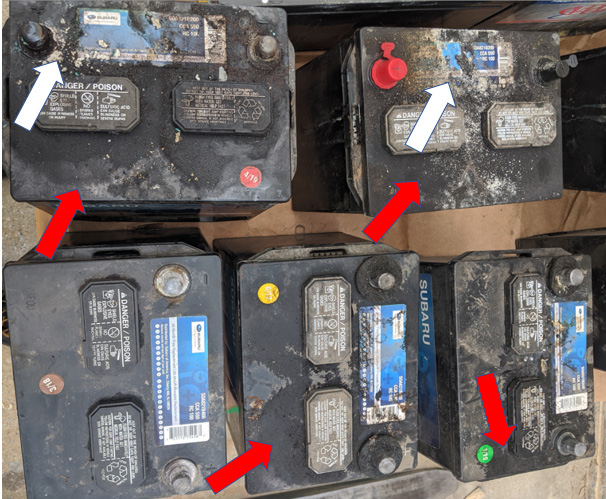
In this collection of returned batteries, the RED arrows point to moisture accumulations which has escaped from either the post seal(s) and / or the covers (fill caps) as a result of normal outgassing, a normal by-product of charging. The two WHITE arrows point to corrosion.
Both are normal conditions and not to be considered defects.
FIGURE B:
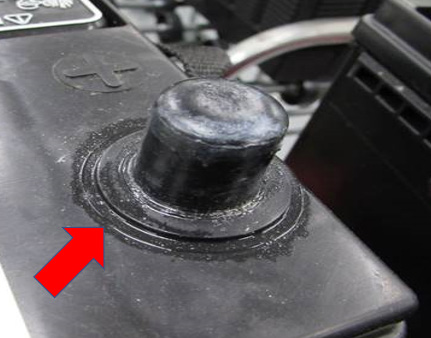
The RED arrow points to moisture seepage seen around the post seal. This photo depicts seepage which should be considered normal and would not be considered a warrantable defect requiring battery replacement.
FIGURES C and D:
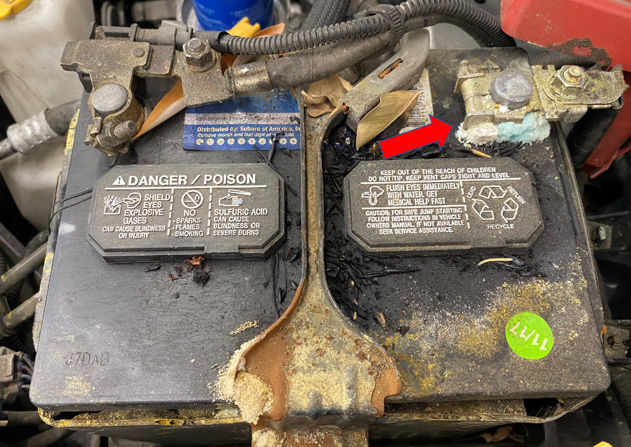
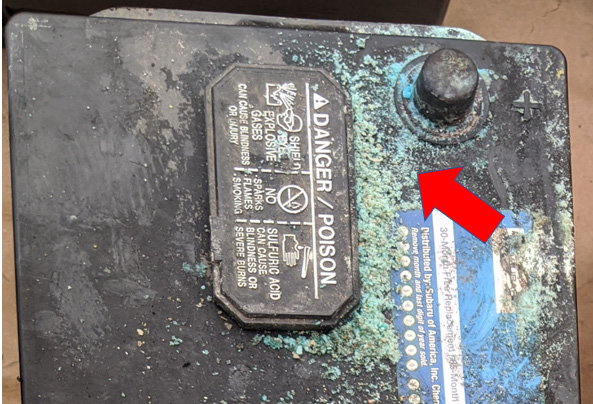
Both photos above show corrosion accumulations which have developed over time resulting from a lack of proper cleaning and / or maintenance. If corrosion develops on the hold-down, if the battery tray or hold-down parts become rusty or, whenever the battery becomes dirty, it is recommended to take the time to remove it from the vehicle and thoroughly clean these parts. Use a wire brush to remove dirt, corrosion and rust. A baking soda and water mixture (toothpaste consistency) or spray neutralizer is recommended for use on the battery cable ends and connectors along with a 2-way battery terminal brush as shown below to clean both the battery posts and inside the terminal ends. The solution also neutralizes the sulfuric acid content embedded in the metals creating the corrosion. A cloth dampened with ammonia or a baking soda/water solution can be used to remove dirt from the top of the battery followed by wiping clean with a damp cloth.
IMPORTANT: Never use any kind of liquid or solution to clean the battery sensor (if equipped).
Once any rust and corrosion has been removed and all connectors are thoroughly cleaned, make sure the battery is completely dry. Reconnect the cables to the battery posts and torque the fasteners to their applicable specification. When complete, application of a thin coating of terminal protectant spray over the connectors and posts to retard corrosion is also recommended.
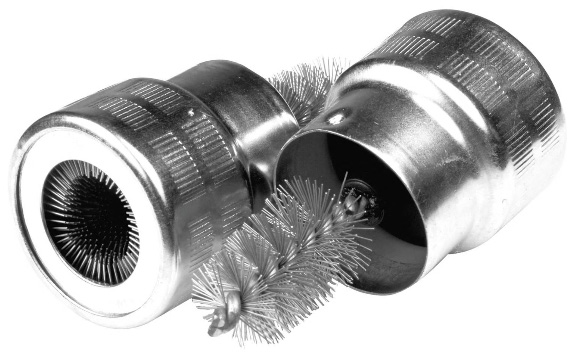
IMPORTANT: Never apply insulating materials (e.g dielectric grease) to the contact surface of the battery post or the inside contact surface of the battery terminal.
FIGURE E:
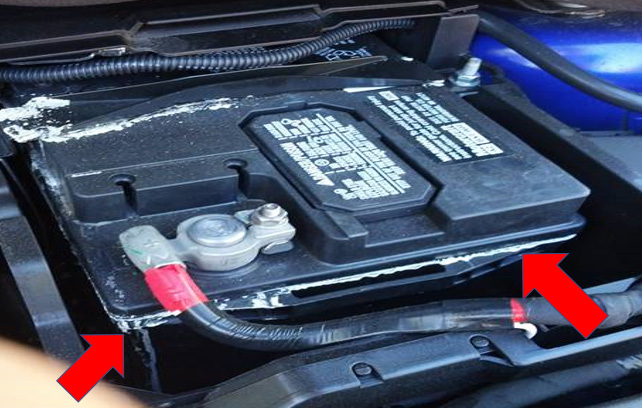
The RED arrows point to moisture seepage around the top cover seal and the start of an accumulation of corrosion. This photo depicts seepage which should be considered excessive and would be considered a warrantable defect requiring battery replacement.
1 Affected Product
Vehicle
1 Associated Document
Manufacturer Communications
NUMBER: 07-186-20
DATE: 12/08/20
MC-10185068-0001.pdf 1694.314KB
NHTSA ID Number: 10191566
Manufacturer Communication Number: Subarunet Announ
Summary
DPSM authorization requirement for leaking batteries.
1 Associated Document
Manufacturer Communications
To: All Subaru Retailers
From: Subaru of America, Inc. – Service Operations Department
Date: April 12, 2021
Re: DPSM authorization requirement for leaking batteries
MC-10191566-0001.pdf 122.022KB
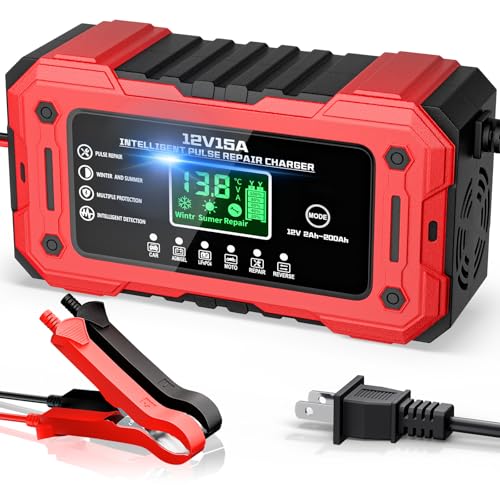
- 3-in-1 Smart Car Battery Charger: This 15A 12V car battery charger comes with a compact size and super fast charging, suitable for all 12V lead-acid batteries (including AGM, GEL, SLA, VRLA, etc.) and LiFePO4 lithium batteries. Charging, maintaining, and trickle charging modes for cars, motorcycles, trucks, boats, and more. Please note: this is a car battery charger and please connect it to a power source before use. (Please do not let the charger operating unattended for more than 12 hours.)
- Plug and Play Operation: Simply connect the clamps to your car battery. The LCD screen will light up and automatically display the battery voltage and ambient temperature. This automatic car battery charger gets to work the moment you plug the AC power cord into a 110-240V (50-60Hz) wall socket, it will automatically detect and charge. You can also manually select from 6 using modes with the press of the “MODE” button.(Input cable length: 102 cm; output cable length: 60 cm.)
- Smart Winter Battery Trickle Charger: This intelligent car battery charger features dual seasonal modes (Winter/Summer) that automatically adjust charging voltage based on ambient temperature, helping prevent undercharging in winter and overcharging in summer. This ensures battery health whether your vehicle is in daily use or stored for months.
- LCD Display: Battery charger comes with a LCD screen shows charging data including voltage, current, battery level, ambient temperature, and seasonal modes (summer/winter), making it easy to stay updated on charging progress.
- Battery Maintenance & Recovery: This smart battery charger features a dedicated pulse repair mode, detects and reverses battery salvation and acid stratification in lead-acid batteries, extending battery life and functionality.
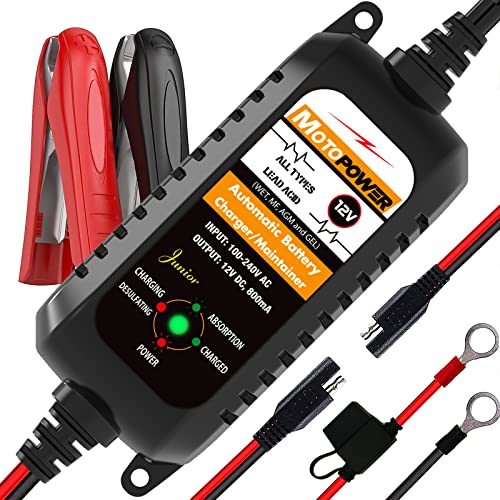
- Charger, Maintainer & Desulfator - An all-weather battery charger, battery maintainer, trickle charger, and battery desulfator. Perfect for charging and maintaining all 12-volt lead-acid, flooded or sealed maintenance free batteries (AGM and gel cell).
- Automatic Desulfation & Optimization - Automatic detection of battery sulfation problem. Applying with pulse current technology to desulfate the batteries effectively. Optimize the battery performance during charging without any manual operation.
- Energy Saving & Spark Free - Zero output in standby mode. No battery drain when connecting with the battery. Spark proof during lead connection for safety.
- Multi-level Safety Protection & Timer Set Up - Overcharge, short circuit and reverse polarity protected. Charge the battery up to 14.4V and Maintain the battery at 13.6V for long time to avoid gasing and to extend the battery life. 24-hour Timer is set up in the program to terminate the charge and enter the maintaining mode once the voltage is above 14V to ensure safety.
- Easy Operation -Just plug-in, connect to the battery and start charging or maintaining your battery. The desulfation is working automatically during the charing. No manual operation.

- PREVENT BATTERY FAILURE: Ensure reliable starts after storage with this 4-in-1 device that charges, maintains, tests, and restores batteries for cars, motorcycles, ATVs, trucks, SUVs, and boats.
- REVIVE DEAD BATTERIES: Delivers 15A rapid charging power to keep standard, AGM, gel, and deep-cycle batteries healthy, making it the perfect garage upgrade for seasonal or infrequently used vehicles.
- EASY OPERATION: Microprocessor controlled with auto voltage detection and smart trickle charging technology for a seamless charging experience.
- MULTI-FUNCTION VALUE: Maximize battery life and performance with advanced desulfation mode, automatic voltage detection for 6V and 12V batteries, and multi-stage charging algorithms.
- COMPLETE PACKAGE: Includes (1) SC1280 Battery Charger and Maintainer, (1) user manual

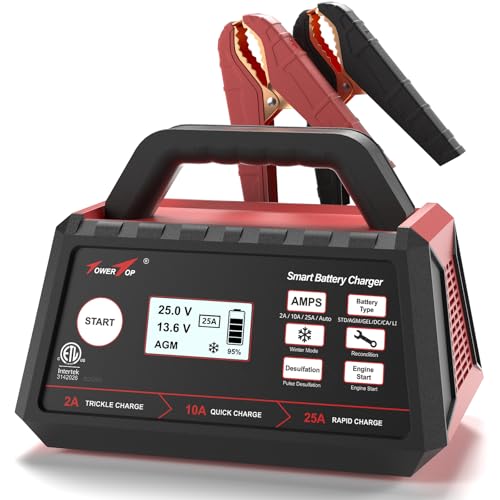
- Efficient, Energy-Saving, and Fast Charging: The TowerTop 12v battery charger offers 4 adjustable current settings (2A/10A/25A/AUTO) to meet your diverse needs. With a max charging current of 25A, you can fully charge a 100Ah battery in under 3.5 hours. Achieving an 85% charging efficiency (industry average 75%), this battery chargers is more efficient, increasing charging speed by 1640% compared to 2A car battery charger. Not only is it energy-efficient, but it also saves you a lot of wait time
- Fully Automatic Charging for Convenience and Safety: This 12 volt battery charger automatically detects battery status and starts charging automatically within 30 seconds if you forget to press Start. After a full charge, it enters pulse repair mode, turns off the screen to save energy, and maintains a safe voltage for long-term storage. If voltage drops, it restores full power. The smart battery charger also remembers your last settings, ensuring seamless operation even after a power outage
- All-in-One Compatible Design: Designed for 12V sealed lead-acid batteries in cars, boats, RVs, power sports, and deep-cycle batteries, including 12V STD, AGM, GEL, Wet, MF, EFB, calcium and deep-cycle batteries
- HD LCD Screen and 8-Stage Intelligent Charging: With true 8-stage smart charging (desulfurization, soft start, bulk charge, absorption, analysis, repair, float, and pulse maintenance), it optimizes battery life and repairs batteries without overcharging or damaging them. The HD LCD screen allows you to view the charging stage and parameters at any time rather than leaving you guessing, keeping you informed of the charging status
- Battery Repair: Independent desulfurization and repair buttons allow you to manually desulfurize and repair your battery to restore lost battery performance, helping to revive old/idle batteries and extend battery life. If your battery cannot be charged, you can try the "repair" mode to fix it. Note: It cannot repair completely drained batteries

- 【Compatibility】Support all Best Choice Products 12V round hole charging port Kids Electric Ride On Car, 12V Battery Charger for Children Ride On Toys Jeep Kid Trax Dynacraft Kids Jeep Car Mercedes-Benz Truck Audi Range Rove BMW I8 Kidzone Bumper Car Charger
- 【Safety Certification】Our 12V Battery Charger have passed Safety certified. Fast charging and provide overcharge protection system/short circuit/overload protection/overheat protection.
- 【AC Input /Output 】Input : 100V -240VAC 50/60Hz. /Output:12VDC 1000MA / 5 Ft Power Cable / 2.1mm x 5.5mm Center Positive Barrel Plug
- 【Smart LED light】 Red light when charging, Green light when full.
- 【After-Sales Service】We provide 1 year warranty service, and 3 month unconditional return. Please contact us with any questions or concerns
SEOCONTENT-START
Bulletin Number: 07-186-20; Date: 12/08/20 Page 1 of 4 Continued… CAUTION: VEHICLE SERVICING PERFORMED BY UNTRAINED PERSONS COULD RESULT IN SERIOUS INJURY TO THOSE PERSONS OR TO OTHERS. Subaru Service Bulletins are intended for use by professional technicians ONLY. They are written to inform those technicians of conditions that may occur in some vehicles, or to provide information that could assist in the proper servicing of the vehicle. Properly trained technicians have the equipment, tools, safety instructions, and know-how to do the job correctly and safely. If a condition is described, DO NOT assume that this Service Bulletin applies to your vehicle, or that your vehicle will have that condition. Subaru of America, Inc. is ISO 14001 Compliant ISO 14001 is the international standard for excellence in Environmental Management Systems. Please recycle or dispose of automotive products in a manner that is friendly to our environment and in accordance with all local, state and federal laws and regulations. NUMBER: 07-186-20 DATE: 12/08/20 APPLICABILITY: All Models SUBJECT: Battery Leaks- Visual Guidelines to Assist with Determining Warranty Coverage INTRODUCTION: This Service Information Bulletin is intended to supply Service and Parts Department personnel with some photographs for use as examples to assist them with determining if a verified leaking battery condition is warrantable or not. These photos and some of the accompanying text have been supplied by Interstate Batteries and we appreciate their support in developing this bulletin. It is important to understand these images are intended to show commonly seen examples of various leaking battery conditions. They are not all Subaru-specific photos or descriptions of conditions limited to only Subaru vehicles. A battery is a perishable item requiring periodic maintenance. With reasonable care, battery life can be significantly extended whereas neglect and abuse will invariably shorten battery life. A routine “under hood” battery inspection can be made during periodic fueling stops. Maintenance should be automatically performed whenever the vehicle is left for other periodic services such as oil changes or minor repairs. Customers appreciate Technicians who remind them of needed services. Battery maintenance is not considered a matter for warranty. The photos below show examples of various conditions commonly seen with vehicle batteries collected after replacement under warranty. When diagnosing a battery “leak” concern, it is extremely important to realize the differences between: • what is to be considered normal “seepage” or moisture accumulation as a result of normal “outgassing”, a by-product of battery charging shown in FIGURE A • normal seepage around the post seals on the top cover of the battery case as shown in FIGURE B • resultant corrosion build-up on terminals, hardware and hold-downs as a result of the points listed above shown in FIGURE C and / or non-defect conditions resulting from lack of proper cleaning and / or maintenance as shown in FIGURE D • an actual defect where the top case cover seal is not sealing properly and causing corrosion to develop as shown in FIGURE E. SERVICE INFORMATION BULLETIN ATTENTION: GENERAL MANAGER q PARTS MANAGER q CLAIMS PERSONNEL q SERVICE MANAGER q IMPORTANT – All Service Personnel Should Read and Initial in the boxes provided, right. © 2020 Subaru of America, Inc. All rights reserved. Bulletin Number: 07-186-20; Date: 12/08/20 Page 2 of 4 Continued… IMPORTANT REMINDER: BOTH the completed Warranty Tag and the REPLACE test printout MUST be attached to any battery expected to be replaced under Warranty by Interstate. FIGURE A: FIGURE B: In this collection of returned batteries, the RED arrows point to moisture accumulations which has escaped from either the post seal(s) and / or the covers (fill caps) as a result of normal outgassing, a normal by-product of charging. The two WHITE arrows point to corrosion. Both are normal conditions and not to be considered defects. The RED arrow points to moisture seepage seen around the post seal. This photo depicts seepage which should be considered normal and would not be considered a warrantable defect requiring battery replacement. Bulletin Number: 07-186-20; Date: 12/08/20 Page 3 of 4 Continued… FIGURES C and D: Both photos above show corrosion accumulations which have developed over time resulting from a lack of proper cleaning and / or maintenance. If corrosion develops on the hold-down, if the battery tray or hold-down parts become rusty or, whenever the battery becomes dirty, it is recommended to take the time to remove it from the vehicle and thoroughly clean these parts. Use a wire brush to remove dirt, corrosion and rust. A baking soda and water mixture (toothpaste consistency) or spray neutralizer is recommended for use on the battery cable ends and connectors along with a 2-way battery terminal brush as shown below to clean both the battery posts and inside the terminal ends. The solution also neutralizes the sulfuric acid content embedded in the metals creating the corrosion. A cloth dampened with ammonia or a baking soda/water solution can be used to remove dirt from the top of the battery followed by wiping clean with a damp cloth. IMPORTANT: Never use any kind of liquid or solution to clean the battery sensor (if equipped). Once any rust and corrosion has been removed and all connectors are thoroughly cleaned, make sure the battery is completely dry. Reconnect the cables to the battery posts and torque the fasteners to their applicable specification. When complete, application of a thin coating of terminal protectant spray over the connectors and posts to retard corrosion is also recommended. IMPORTANT: Never apply insulating materials (e.g dielectric grease) to the contact surface of the battery post or the inside contact surface of the battery terminal. Bulletin Number: 07-186-20; Date: 12/08/20 Page 4 of 4 FIGURE E: IMPORTANT REMINDERS: • SOA strongly discourages the printing and/or local storage of service information as previously released information and electronic publications may be updated at any time. • Always check for any open recalls or campaigns anytime a vehicle is in for servicing. • Always refer to STIS for the latest service information before performing any repairs. The RED arrows point to moisture seepage around the top cover seal and the start of an accumulation of corrosion. This photo depicts seepage which should be considered excessive and would be considered a warrantable defect requiring battery replacement.
**************************************************************************************************************
To: All Subaru Retailers From: Subaru of America, Inc. – Service Operations Department Date: April 12, 2021 Re: DPSM authorization requirement for leaking batteries In December, we released a Technical Service Bulletin (TSB) offering additional information to retailers to assist in determining warranty coverage for a suspected battery leak (07-186-20). There has been significant concern that when batteries claimed to be leaking are collected and inspected, there is in fact no evidence of what the battery industry defines as a leak. The intension of the TSB was to supply Service and Parts Department personnel with some photographs for use as examples to assist in determining if a verified battery is in fact leaking and if the leaking battery condition is warrantable or not. While we have seen the number of leaking battery claims decrease slightly, there are still an inordinate amount of leaking battery claims being submitted. Beginning today, 4/12/21, all leaking battery claims, regardless of claim type, will require DPSM authorization. Please use TSB 07-186-20 as a guide to help in identifying whether a battery is leaking. If a battery is identified as having a warrantable leak, use the “Leaking/cracked battery” authorization reason when creating an authorization request and include photos clearly showing the leaking battery to the authorization. While photos are not required to submit the authorization, they are required for a DPSM to review the authorization for approval. Should you have any questions, please contact the Claims Helpline 866-782-2782.
SEOCONTENT-END
This product presentation was made with AAWP plugin.