
NHTSA ID Number: 10225744
Manufacturer Communication Number: 07-178-21R
Summary
This bulletin is being released as guidance for proper testing and charging of vehicle batteries.
NUMBER: 07-178-21
DATE: 11/15/21
REVISED: 10/03/22
| APPLICABILITY: | All MYs / All Models |
| SUBJECT: | Battery Testing and Charging |
INTRODUCTION:
This Service Information bulletin is being released as guidance for proper testing and charging of vehicle batteries. This bulletin will focus on those required procedures necessary to ensure the best possible outcome.
This bulletin contains the following sections / topics:
- Required tools and related training for effective use and application
- Proper identification of battery types used by Subaru and specifics about handling each • Warnings and Cautions when testing and charging batteries using the required tools
- Required battery testing and evaluation criteria and instructions.
TOOL INFORMATION:
Knowledge base sites –helpful hints, user manuals:
- DSS-5000: https://subaru.dss5000.com/
Use for quick analysis of the battery condition:
- Cranking Condition – Battery’s ability to start the vehicle
- Reserve Capacity – Battery’s ability to power accessory loads for extended periods of time.
- DCA-8000: https://subaru.dca8000.com/
Use when Recharge decisions are reached from the DSS-5000 or, in the event of a customer complaint regarding battery performance:
- Cranking Condition – Battery’s ability to start the vehicle
- Reserve Capacity – Battery’s ability to power accessory loads for extended periods of time
- DCA-8000 Decision – Dynamic Charge Acceptance – Battery’s ability to accept charge after time spent in a discharged condition
- Defect detection – additional fault detection for Cranking, Reserve Capacity, and other factors reducing battery performance.
NOTE: If any issues are experienced with the DSS-5000 or DCA-8000, the Midtronics Technical Customer Support line is available at: 866-592-8052.
IDENTIFYING BATTERIES:
The two battery types Subaru uses are (see example images below):
VEHICLE APPLICATIONS:
- EFB –Utilized on Models equipped with Stop / Start ONLY:
NOTE: 2019-22MY Ascent and 2017-22MY Impreza could have either an EFB or Flooded battery.
- Flooded –All other Subaru models and Model Years
There are additional selections of battery types supported by the Midtronics tools which are not applicable to Subaru: (AGM, AGM Spiral, Gel). IMPORTANT: With the latest Midtronics software update (Q2, 2021, version “G” for DCA-8000 and “M” for DSS-5000),critical battery information (battery type and CCA) which previously populated automatically after VIN entry is now REQUIRED to be entered accurately by the Technician.
ENHANCED FLOODED BATTERIES (EFB) KEY POINTS:
EFB batteries require different charging and testing logic:
- Charging with incorrect battery type entered can damage the battery.
- Testing with incorrect battery type entered can produce incorrect results.
EFB battery types currently being used:
- Q85 –2019-22MY Forester, 2020-22MY Crosstrek with CVT, 2019-22MY Ascent* and 2017-22MY Impreza*
- LN2 –2020-22MY Legacy and Outback
- 55N –2014-16MY Crosstrek Hybrid
REMINDER: 2019-22MY Ascent and 2017-22MY Impreza could have either an EFB or Flooded battery.
| Standard Flooded Type
CCA will vary by application | LN2 type EFB
2020-22MY Legacy and Outback |
Q85 Type EFB
2019-22MY Forester and 2020-22MY Crosstrek with CVT, 2019-22MY Ascent and 2017-22MY Impreza
WARNINGS:
- Because batteries produce flammable gases, never bring any open flame close to the batteries.
- Ventilate sufficiently when using or charging batteries in an enclosed space.
- Electrolyte is a highly corrosive acid and has toxicity; use gloves and ALWAYS wear eye protection whenever handling the fluid or cleaning any deposits / residue from the battery.
- For safety, in case an explosion does occur, always wear eye protection when working near any battery. In addition, never lean over the battery.
- Always prevent electrolyte from coming into contact with skin, eyes or clothing. Especially if coming in contact with eyes, flush with water for 15 minutes and get prompt medical attention.
- Always prevent electrolyte from coming contact with any coated or painted surfaces.
- Before starting work, remove rings, metal watchbands or other metal jewelry.
- Never let any metal tools contact the positive battery terminal and possibly ground / short out against anything close to it.
- When operations using a metal tool on the positive terminal or anything connected to it are required, CAREFULLY disconnect the ground terminal while supporting the battery sensor with the other hand before proceeding. IMPORTANT: Always consult the applicable Service Manual for proper Battery Sensor servicing procedures.
- Always follow the manufacturer’s instructions when handling the battery charger.
Battery Inspection:
- Check the battery case, top cover and terminals for dirt or cracks, and perform the following work as necessary:
- If terminal posts are corroded, the terminals must be removed and cleaned.
- It may be necessary to test the battery with both terminals removed to ensure a good test connection with the clamps.
- Clean with a brush and common baking soda solution.
Connecting Testers/Chargers to the Battery:
- Before disconnecting the battery, ensure the vehicle has been switched off with all the doors closed for a minimum of 60 seconds.
- If the battery voltage is less than 8 volts, it is required to use the Subaru Midtronics DCA-8000 Dynamic Diagnostic Charging System.
- Connecting the clamps:
- Always confirm the clamp teeth are clean and free of corrosion.
- Disconnect the ground terminal or CAREFULLY remove the ground cable from the battery sensor to prevent damage to alternator diodes or other electrical components.
IMPORTANT: Always consult the applicable Service Manual for proper Battery Sensor servicing procedures.
-
- Connect the clamps directly to the battery post/terminal. Avoid connecting to the terminal bolt/nut. NEVER connect the tester/charger ground clamp to a body or engine ground point. Use ONLY the battery posts or terminal clamps for testing and / or charging.
- Rock/rotate clamps to ensure a clean connection onto the battery post/terminal.
IMPORTANT: Never connect the negative clamp to a point that will position the battery sensor between the clamp and negative battery post.
DCA-8000 Main Menu Options:
- In-Vehicle Charge and Test:
- Warranty test for use when the battery is in the vehicle or when a system test is needed.
- NOTE: This is the only test to be used in warranty situations.
- Out of Vehicle Charge:
- Non-warranty test for use when the battery is on the bench (an in-vehicle test can also be used on the bench as long as the VIN is entered). Performs charge and test functions.
- Manual Charge:
- Use when needing to charge a battery without running a full diagnostic test procedure. IMPORTANT: NEVER exceed the default time of (1 hr.) or use this mode without closely monitoring the battery.
- Should not be used in normal situations but may be used when battery voltage is too low to begin an “In Vehicle Charge and Test”.
- Power Supply mode:
- Use when performing any vehicle reprogramming functions.
- IMPORTANT: ALWAYS set the power supply voltage to 13.5 Volts when using Power Supply Mode. NEVER turn the ignition switch on when charging at voltages 15 Volts or higher.
- Jump Start:
- Use to jump-start a vehicle with a dead or deeply discharged battery.
- After New Battery Install:
DSS-5000 Main Menu Options:
- In Vehicle Test:
- Out of Vehicle Test:
- To be used for testing out-of-vehicle batteries for possible return / replacement.
- After New Battery Install:
- Express Test:
Vehicle Identification:
- In most cases, the vehicle will be recognized when a VIN scan is performed.
- Pre-populated fields include: VIN, Year, Make, Model, Technology (Hybrid, Gasoline, EV, Start-Stop, etc.), Test Location (Top Post, Side Post, Remote). IMPORTANT
REMINDER: With the latest Midtronics software update (Q2, 2021, version “G” for DCA-8000 and “M” for DSS-5000), critical battery information (battery type and CCA) which previously populated automatically after VIN entry is now REQUIRED to be entered accurately by the Technician.
NOTE: The VIN schematic data follows vehicle launch. There will be a delay between the on sale dates for new models / model years and the corresponding Midtronics software update release timing.
For this reason, the VIN of a newly-launched vehicle may not be recognized right away.
Vehicle Identification: VIN Scan:
Scan the VIN. If the VIN bar code is not available, use manual entry to type in the VIN.
Vehicle Identification: VIN recognized:
Scan the VIN. If the VIN is recognized, the tool will decode the VIN or pre-populate the vehicle information. The Technician must now accurately select the Battery Type from the drop-down menu and enter the Battery / Cranking Rating (CCA) value (use of CCA for the Battery Units is required).
Vehicle Identification: VIN not recognized:
Scan the VIN –if the VIN is not recognized, the tool will not decode the VIN or pre-populate the vehicle information. The Technician will need to accurately select the Battery Type from the drop-down menu and enter the Battery / Cranking Rating (CCA) to receive a Warranty Test Code.
NOTE: The VIN will be captured and recorded in the BMIS for future reference and traceability.
Discharged Battery Testing in General:
IMPORTANT: Effective testing and diagnosis of customer concerns regarding battery discharge or a dead battery starts with a thorough customer interview.
It is critical to understand how and when the condition was first recognized by the customer, events occurring prior to that time, and how the condition was addressed when identified.
As examples, the following questions may provide needed insights to help avoid subsequent failures or may and or explain the battery’s current condition:
- When was the condition identified? Was it during the first start in the morning or after driving?
- How long had the vehicle been parked prior to this occurrence?
- How was the vehicle used just prior to or after being parked?
- When the condition was found, how was it addressed? Was the car jump-started? If yes, how?
- What are the customer’s normal driving habits? Is the car driven daily? What are the typical distances being driven?
Additionally, as part of any diagnosis of a discharged battery, if a root cause for the condition is not identified (i.e. map lamp left on or similar), it is critical to ensure no condition exists on the vehicle side that could result in a future discharged battery. This testing includes the completion of a correctly performed parasitic / dark current draw test based on the information supplied by the customer. See TSBs 07-85-14, 07-62-07 and 07-199-21 for more information on dark current testing procedures.
Interpreting DSS-5000 and DCA-8000 Test Results:
Battery Diagnostics Overview:
The ongoing advancement of vehicle electrical systems requires batteries to do much more than just start the engine. While diagnosing the cranking ability of the battery is important, evaluating Reserve Capacity and Dynamic Charge Acceptance (when applicable) provides a holistic view of battery health:
- Reserve Capacity is the battery’s ability to support loads when the engine is off or when the alternator is in a low output phase.
- Dynamic Charge Acceptance is the battery’s ability to discharge and recharge quickly to support the Stop/Start system.
The DSS-5000 is limited to diagnosing the Cranking ability and Reserve Capacity since it cannot charge the battery. However, the additional capabilities of the DCA-8000 provide diagnostics on all these failure modes plus, it monitors the battery during a Diagnostic Charge to ensure the battery can be recovered in an adequate amount of time.
NOTE: These results should align with the DCA-8000 “Cranking/Charging Result” and “Reserve Result”.
Some exceptions may occur:
- Back to back testing or pre-charging before a 2nd test is performed can cause measurements to respond differently masking bad batteries from being identified or, cause good batteries to incorrectly be diagnosed as failed.
- If Diagnostic Charging is selected, results may vary from a tester due to changes in battery condition.
- The DSS-5000 cannot perform Charge Acceptance or Defect detection tests and may cause variations in Overall Decisions during the Battery Test (see “Interpreting DCA-8000 Results” for defect explanation).
DSS-5000 Decision Breakdown:
Overall/Cranking:
- Good Battery – Battery is Good and can be returned to service.
- Good Recharge – Battery is Good, but discharged. Use the DCA-8000 in “Vehicle Charge and Test” mode to charge the battery and return it to service.
- Charge & Retest – Battery condition is discharged and should be charged for a decisive evaluation. Charge the battery using the DCA-8000 Diagnostic Charger in “Vehicle Charge and Test” mode for a final decision.
- Replace Battery – Battery is faulty and should be replaced before returning the vehicle to the customer. NO FURTHER TESTING SHOULD BE ATTEMPTED. ALWAYS record the displayed battery test code.
- Bad-Cell Replace – Battery is faulty and should be replaced before returning the vehicle to the customer. NO FURTHER TESTING SHOULD BE ATTEMPTED. ALWAYS record the displayed battery test code.
Reserve Capacity Result (CP):
- OK – Reserve Capacity is good and the battery should be handled according to the Overall Decision.
- Warning – Battery has poor reserve capacity and should be replaced before returning the vehicle to the customer.
- Low Battery – Battery being tested is too discharged to perform the CP test.
- Internal Battery Low – The AA batteries inside DSS-5000 base unit need to be replaced to allow proper testing.
- Conditions Not Met – Vehicle conditions have prevented the DSS-5000 from performing the Reserve Capacity test. Before attempting any retest and to ensure the battery is properly prepared, confirm the ground cable has been removed from the battery sensor (if equipped) or the negative battery post on older models.
Test Result: Charge and Retest Use DCA -8000:
If the DSS-5000 returns the result of “Charge and Retest Use DCA”.
- DO NOT keep repeating the test with the DSS-5000.
- Use the DCA-8000.
IMPORTANT: With the battery properly prepared and the tester properly configured, no more than ONE test using the DSS-5000 should be performed. If the DSS-5000 recommends recharging, retesting or both, the DCA-8000 must be used (and properly configured prior to use) to perform those functions.
Interpreting DCA-8000 Results:
DCA-8000 Decision Breakdown:
- Cranking/Charging Result: Decision aligns with the battery’s ability to pass a Half CCA load test.
- DCA-8000 Result (Charge Acceptance): Decision aligns with the battery’s ability to quickly accept a charge and recover after use during Key Off power consumption or Start/ Stop vehicle systems (EFB type battery only).
- Defect Result: Decision ONLY appears when a battery fails for testing / detection methods only capable of being performed specifically by the DCA-8000 Diagnostic Charger.
- Overall Decision: The decision requires all of the above results to be good. If any of the above results are suspect (Replace), battery replacement is recommended.
DCA-8000 Decision Explanation:
Overall/Cranking:
Determines battery’s overall condition and ability to start the vehicle.
- Good Battery – Battery is good and can be returned to service.
- Good Recharge – Battery is good, but discharged. Use DCA -8000 to charge the battery and return it to service. (If this decision was reached during a Diagnostic Charge, the process was aborted before the battery was fully charged.)
- Charge & Retest – Battery condition is discharged and should be charged for a decisive evaluation. Charge the battery using the DCA-8000 Diagnostic Charger for a final decision. a. If a Battery is determined Charge & Retest, use the Diagnostic Charge mode in the DCA-8000 to get a Replace or Good Battery decision.
- Replace Battery – Battery is faulty and should be replaced before returning the vehicle to the customer.
- Bad-Cell Replace – Battery is faulty and should be replaced before returning the vehicle to the customer. Charging is not recommended for safety purposes.
Reserve Result (CP):
Determines battery’s ability to support Key Off accessory loads.
- OK – Reserve Capacity is good and battery should be handled according to the Overall Decision.
- Warning – Battery has poor reserve capacity and should be replaced before returning it to the customer.
- Low Battery – Battery being tested is too deeply discharged to perform the CP test.
DCA-8000 Charge Acceptance Result:
Determines the battery’s ability to accept charge and recover after Key Off accessory draw.
- Good CA – Battery recovers at an acceptable rate and can continue service.
- Poor CA – Battery cannot recover charge and should be replaced.
Defect Results:
Additional detection methods utilized by the DCA-8000 diagnostic capabilities:
- Replace – Cranking fault has been identified that did not utilize conductance.
- Broken Weld – Load performance indicates a broken weld and battery replacement is recommended.
- Hard Short – A hard short has been detected and battery replacement is recommended.
- RC Warning – Reserve capacity problems have been identified using a method other than the RC test performed by the DSS-5000.
Best Practice: VIN tagging the battery
If the battery is removed from the car for testing or replacement, place a bar code sticker of the VIN on the battery if available. If a bar code sticker is not available, a piece of masking tape or equivalent with the last 8 digits of the VIN CLEARLY written on it will suffice. This provides traceability for the battery and any tests or charging performed.
If the battery is to be covered under Warranty, the VIN, test result and test code MUST be secured to the battery using a Warranty tag, masking tape, etc.
VERY IMPORTANT: There must be CLEARLY written indications on the Warranty Tag of the following:
- Coverage Type: Warranty
(WC), Parts Warranty (PW) or Policy Adjustment (PA) .
- Pick-Up Date: Batteries replaced under any of the Coverage Types listed above MUST be retained for at least 40 days after the CLAIM APPROVAL DATE (NOTO. Date) before they are eligible to be picked up by the Interstate Batteries (IB) representative. Therefore, there must be clear indication to the IB representative that the battery in question is not available to be picked up until AFTER the listed “Pick Up After” date.
Leaking Batteries:
Refer to TSB 07-186-20 for detailed information regarding identification of leaking batteries.
Replacing a battery:
- Always remember to record the customer’s radio station presets and navigation favorites before disconnecting the battery and to reset them when replacement is complete.
- NEVER replace an EFB battery with a flooded battery. Use ONLY the battery specified for the vehicle.
- When testing a new replacement battery, use the After New Battery Install function of either the DSS-5000 or the DCA-8000 to perform the test.
27 Affected Products
Vehicles
| MAKE | MODEL | YEAR |
| SUBARU | ASCENT | 2019-2022 |
| SUBARU | CROSSTREK | 2020-2022 |
| SUBARU | CROSSTREK HYBRID | 2016, 2020-2022 |
| SUBARU | FORESTER | 2019-2022 |
| SUBARU | IMPREZA | 2017-2022 |
| SUBARU | LEGACY | 2020-2022 |
| SUBARU | OUTBACK | 2020-2022 |
1 Associated Document
Manufacturer Communications
NUMBER: 07-178-21R
DATE: 11/15/21
REVISED: 10/03/22
NHTSA ID Number: 10231301
Manufacturer Communication Number: 07-178-21R
Summary
This Service Information bulletin is being released as guidance for proper testing and charging of vehicle batteries.
1 Associated Document
Manufacturer Communications
NUMBER: 07-178-21R
DATE: 11/15/21
REVISED: 01/11/22
MC-10231301-0001.pdf 5981.011KB
NHTSA ID Number: 10203905
Manufacturer Communication Number: 07-178-21
Summary
This bulletin is being released as guidance for proper testing and charging of vehicle batteries. This bulletin will focus on those required procedures necessary to ensure the best possible outcome.
1 Associated Document
Manufacturer Communications
NUMBER: 07-178-21
DATE: 11/15/21
MC-10203905-0001.pdf 2710.831KB

- Catch Battery Problems Early: Featured in two videos by Project Farm, a popular YouTube channel with millions of subscribers, the ANCEL BA101 helps you quickly spot battery issues before they leave you stranded. It provides easy-to-understand readings for State of Health (SOH), State of Charge (SOC), voltage, current, CCA, plus cranking and charging system tests, so you can better understand your battery and help avoid unexpected breakdowns
- Know the Real Condition: Don’t let inaccurate readings lead to costly surprises. Built with high-quality copper crocodile clips and a precision smart chip, this battery tester is designed to deliver dependable results. For the most accurate test, enter the correct battery type, rating value (such as CCA/Ah), and temperature exactly as shown on your battery label, so you get a clearer picture of your battery’s true condition
- Fast, Clear, Hassle-Free Testing: The classic black-and-white screen, adjustable contrast, and white backlight make results easy to read in bright sunlight or low-light conditions. One-handed operation keeps testing simple, while direct power from your vehicle’s battery means no charging and no internal batteries to deal with. Multi-language support makes it easier for more users to test with confidence
- Protection When Mistakes Happen: Built-in 4-in-1 protection helps guard against reverse polarity, short circuits, overcurrent, and overvoltage for safer testing, especially in tight spaces where clamp slips or wiring mistakes can happen. The 3x reinforced ABS housing adds extra durability and helps protect both the tester and your battery during everyday use
- Built for More 12V Batteries: Supporting global standards including JIS, EN, DIN, SAE, BCI, GB, CA, MCA, and IEC, this tester works with 12V batteries used in cars, trucks, boats, RVs, ATVs, lawnmowers, golf carts, and motorbikes over 30Ah. Compatible with Flooded, AGM, GEL, and EFB batteries. Not for lithium batteries, non-12V batteries (6V/8V/24V), or motorcycles below 30Ah. For 6V testing, choose BA101 Plus. For 24V testing, choose BA101 PRO

- [Car Battery Tester] You can easily test and inspect your 12V lead-acid battery with this TOPDON car battery tester. The SOH (State of Health), SOC (State of Charge), Voltage, Current, Rating, and numerous other understandable analytical data are provided by this battery tester. It is compatible with 100-2000CCA regular flooded, AGM flat plate/spiral, EFB, and GEL for their optimum performance.
- [Wide Application] This 12V battery load tester can only be powered on once it is properly attached thanks to a safe passive testing approach. You may test the batteries of a number of vehicles, including cars, motorbikes, trucks, RVs, ATVs, SUVs, boats, yachts, lawnmowers, and even golf carts, without needing to charge the device first.
- [3 Testing Function] A battery health test will determine whether or not the battery is in excellent operating order. A cranking test will determine whether or not the electrical system has sufficient power to start the engine. Check to see that the charging current, rectifier diode, and generator are all functioning normally. This handy auto battery analyzer makes sure your summer road trips won’t end on a flat.
- [Ergonomic Features] To help you rapidly determine the health of the battery, this load battery tester is built with three different colors of LEDs. It's easy to use because it operates through a menu system. Additionally, for a reliable and secure connection during the testing process, premium-quality copper clamps have polarity reverse prevention and spark proof features.
- [Great Choice] The TOPDON BT100 is small and compact, making it simple to keep in a glove box or center console. This battery load tester's rapid and precise results will enable you to decide whether your car battery needs to be replaced or jump-started making it an excellent choice for auto shops, garages, and DIY users who frequently check batteries.

- 🔥【A MUST HAVE TOOL IN YOUR GARAGE】 - With up-to-date testing technology, it provides a quick reading to determine whether a vehicle battery needs a jump or replacement and also the output status of the alternator. All you have to do is log in and play. Save your time and money.
- 🔥【BATTERY HEALTH CONTROL】 - Applied with the latest test algorithm, the tester will analyze the battery and get the results in seconds, including health status, charging status, internal resistance and test conclusion (mediocre, good, excellent). All types of 12V 100-2000CCA lead acid batteries can be tested.
- 🔥【START AND CHARGE SYSTEM TEST】 - Test the starting voltage of the alternator when starting the engine to see if it is low or under normal conditions. Check the continuous power of the alternator when the engine is running to see if the alternator provides adequate power to the battery and electrical system.
- 🔥【Real Time Wave Display & Data Printing】 - When you need more details about the performance of your battery or alternator when working, you can use the wave viewing function to monitor the output curve in real time. It gives you all the detailed changes of the output.
- 🔥【3 inch color LCD screen and 9 languages supported】 - The 3 inch color LCD screen (240 x 320 pixels) is user-friendly and easy to read. Give you a more comfortable viewing experience with every inspection. 9 languages supported - English, Spanish, French, German, Italian, Russian, Portuguese, Chinese and Polish.
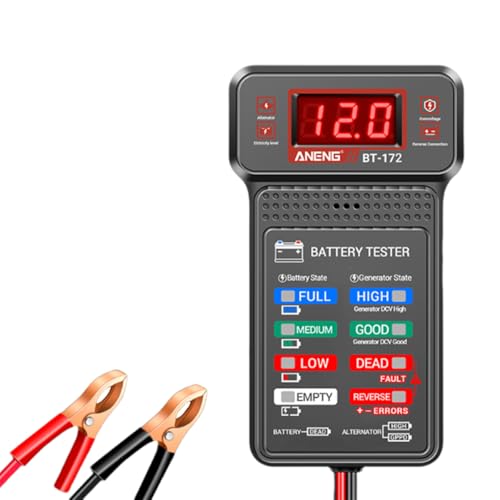
- 【Reliable Car Battery Tester】: The alternator tester can accurately determine whether the car battery needs to be replaced or if there is a power outage, and at the same time evaluate the output status of the alternator, clearly presents real-time voltage data, battery health and charging status. It can effectively prevent the battery from being damaged due to overcharging or undercharging, and extend the battery's service life.
- 【Clear LED Display】: The car battery tester is equipped with a digital display LED screen, which can clearly present the measurement values at night, providing strong assistance for measurement work and allowing you to easily read the data.
- 【Easy to Use】: This car battery capacity analysis is simple and convenient. You just need to connect the positive and negative poles correctly to the alternator. Connect the red clip to the positive pole and the black clip to the negative pole. When the battery is fully charged, the "FULL" display will light up. When the battery is too high, the "HIGH" display will light up. When the battery is low, the "LOW" display will light up. When the battery is dead, the "EMPTY" display will light up.
- 【Protection Features】: The car battery tester includes reverse connection protection and over-voltage protection, which can effectively prevent damage caused by wiring errors. When the positive and negative poles are reversed, the LED display will not show, the "REVERSE" LED will light up and a buzzer alarm will sound. If the voltage exceeds the safety threshold, the "HIGH" indicator will light up immediately, triggering the device's over-voltage protection mechanism.
- 【Widely Used】: The alternator tester is suitable for measurement in most vehicles equipped with 12V batteries, such as cars, off-road vehicles, trucks, motorcycles, ships, golf carts, lawnmowers, etc. It can meet your diverse testing needs.

- 【Reliable Automotive Car Battery Tester】 KW208 is the most cost-effective battery load tester compared to other brands, it has all the functions you need and the lowest cost that you can afford. KW208 can test all 12V batteries(100-2000CCA) including regular flooded, AGM flat plate, AGM spiral or gel batteries. Provide overall analysis of batteries’ condition and help you know their status in advance before it dies. KW208 battery analyzer supports cranking and charging system tests also alternator and starter test. Conveniently store this car battery tester for batteries in your glove box or garage, ready for use whenever needed.
- 【Galvanized Alloy Battery Clips】This battery tester has updated it's clips since 2025, thanks for the galvanized alloy battery clips, it's more durable also bring lager contact when connected with battery, it greatly improved the testing accuracy(99.7%) also safer with fully wrapped material. KW208 12V battery load tester gives you reliable and overall battery parameters such as voltage, internal resistance, cold cranking amp and AH capacity, battery health and charge status. Additionally, battery cca tester will also show you professional advice whether to replace or recharge the battery. NEW REPLACEMENT AVAILABLE FOR ANY QUALITY ISSUE.
- 【 >99.7% High Accuracy】Thanks to KW208 meter‘s powerful and smart AI chip, it provides more than 99.7% precise testing results within milliseconds, greatly improving the testing speed and testing accuracy compared to other battery testers. Besides KW208 is the only battery tester that has over 7000+ rating and is the most reliable and popular car battery tester on Amazon.
- 【Plug and Play】 KW208 12 volt battery load tester and analyzer allows you to test batteries both in-vehicle and out-of-vehicle, and even test dead batteries. Just connect the tester’s clips with battery then it will turn on and be ready to test and analyze battery. It’s that easy! Definitely KW208 is your best choice for there is no need to spend more expensive cost to purchase battery testers as their functions are the same.
- 【Starter& Alternator Tester】KW208 not only a great car battery load tester that tests batteries cranking & charging system but also can test alternator's charging and starter's cranking conditions. And it can also switch up to 8 languages for different needs.
SEOCONTENT-START
Bulletin Number: 07-178-21R; Revised: 10/03/22 Page 1 of 11 Continued… APPLICABILITY: All MYs / All Models SUBJECT: Battery Testing and Charging CAUTION: VEHICLE SERVICING PERFORMED BY UNTRAINED PERSONS COULD RESULT IN SERIOUS INJURY TO THOSE PERSONS OR TO OTHERS. Subaru Service Bulletins are intended for use by professional technicians ONLY. They are written to inform those technicians of conditions that may occur in some vehicles, or to provide information that could assist in the proper servicing of the vehicle. Properly trained technicians have the equipment, tools, safety instructions, and know-how to do the job correctly and safely. If a condition is described, DO NOT assume that this Service Bulletin applies to your vehicle, or that your vehicle will have that condition. Subaru of America, Inc. is ISO 14001 Compliant ISO 14001 is the international standard for excellence in Environmental Management Systems. Please recycle or dispose of automotive products in a manner that is friendly to our environment and in accordance with all local, state and federal laws and regulations. INTRODUCTION: This Service Information bulletin is being released as guidance for proper testing and charging of vehicle batteries. This bulletin will focus on those required procedures necessary to ensure the best possible outcome. This bulletin contains the following sections / topics: • Required tools and related training for effective use and application • Proper identification of battery types used by Subaru and specifics about handling each • Warnings and Cautions when testing and charging batteries using the required tools • Required battery testing and evaluation criteria and instructions. TOOL INFORMATION: Knowledge base sites –helpful hints, user manuals: • DSS-5000: https://subaru.dss5000.com/ Use for quick analysis of the battery condition: a. Cranking Condition – Battery’s ability to start the vehicle b. Reserve Capacity – Battery’s ability to power accessory loads for extended periods of time. • DCA-8000: https://subaru.dca8000.com/ Use when Recharge decisions are reached from the DSS-5000 or, in the event of a customer complaint regarding battery performance: a. Cranking Condition – Battery’s ability to start the vehicle b. Reserve Capacity – Battery’s ability to power accessory loads for extended periods of time c. DCA-8000 Decision – Dynamic Charge Acceptance – Battery’s ability to accept charge after time spent in a discharged condition d. Defect detection – additional fault detection for Cranking, Reserve Capacity, and other factors reducing battery performance. NOTE: If any issues are experienced with the DSS-5000 or DCA-8000, the Midtronics Technical Customer Support line is available at: 866-592-8052. NUMBER: 07-178-21R DATE: 11/15/21 REVISED: 10/03/22 SERVICE INFORMATION BULLETIN ATTENTION: GENERAL MANAGER q PARTS MANAGER q CLAIMS PERSONNEL q SERVICE MANAGER q IMPORTANT – All Service Personnel Should Read and Initial in the boxes provided, right. ©2021 Subaru of America, Inc. All rights reserved. Bulletin Number: 07-178-21R; Revised: 10/03/22 Page 2 of 11 Continued… IDENTIFYING BATTERIES: The two battery types Subaru uses are (see example images below): • Standard flooded batteries (Flooded) • Enhanced Flooded Batteries (EFB) VEHICLE APPLICATIONS: • EFB –Utilized on Models equipped with Stop / Start ONLY: ○ 2020-22MY Legacy and Outback ○ 2019-22MY Forester ○ 2019-22MY Ascent ○ 2017-22MY Impreza ○ 2020-22MY Crosstrek with CVT ○ 2014-16MY Crosstrek Hybrid (Engine Restart Battery only) Hybrid Power Control Module (HPCM) NOTE: 2019-22MY Ascent and 2017-22MY Impreza could have either an EFB or Flooded battery. • Flooded –All other Subaru models and Model Years There are additional selections of battery types supported by the Midtronics tools which are not applicable to Subaru: (AGM, AGM Spiral, Gel). IMPORTANT: With the latest Midtronics software update (Q2, 2021, version “G” for DCA-8000 and “M” for DSS-5000),critical battery information (battery type and CCA) which previously populated automatically after VIN entry is now REQUIRED to be entered accurately by the Technician. ENHANCED FLOODED BATTERIES (EFB) KEY POINTS: EFB batteries require different charging and testing logic: • Charging with incorrect battery type entered can damage the battery. • Testing with incorrect battery type entered can produce incorrect results. EFB battery types currently being used: • Q85 –2019-22MY Forester, 2020-22MY Crosstrek with CVT, 2019-22MY Ascent* and 2017-22MY Impreza* • LN2 –2020-22MY Legacy and Outback • 55N –2014-16MY Crosstrek Hybrid REMINDER: 2019-22MY Ascent and 2017-22MY Impreza could have either an EFB or Flooded battery. Standard Flooded Type CCA will vary by application LN2 type EFB 2020-22MY Legacy and Outback Bulletin Number: 07-178-21R; Revised: 10/03/22 Page 3 of 11 Continued… Q85 Type EFB 2019-22MY Forester and 2020-22MY Crosstrek with CVT, 2019-22MY Ascent and 2017-22MY Impreza WARNINGS: • Because batteries produce flammable gases, never bring any open flame close to the batteries. • Ventilate sufficiently when using or charging batteries in an enclosed space. • Electrolyte is a highly corrosive acid and has toxicity; use gloves and ALWAYS wear eye protection whenever handling the fluid or cleaning any deposits / residue from the battery. • For safety, in case an explosion does occur, always wear eye protection when working near any battery. In addition, never lean over the battery. • Always prevent electrolyte from coming into contact with skin, eyes or clothing. Especially if coming in contact with eyes, flush with water for 15 minutes and get prompt medical attention. • Always prevent electrolyte from coming contact with any coated or painted surfaces. • Before starting work, remove rings, metal watchbands or other metal jewelry. • Never let any metal tools contact the positive battery terminal and possibly ground / short out against anything close to it. • When operations using a metal tool on the positive terminal or anything connected to it are required, CAREFULLY disconnect the ground terminal while supporting the battery sensor with the other hand before proceeding. IMPORTANT: Always consult the applicable Service Manual for proper Battery Sensor servicing procedures. • Always follow the manufacturer’s instructions when handling the battery charger. Battery Inspection: • Check the battery case, top cover and terminals for dirt or cracks, and perform the following work as necessary: ○ Clean the battery with water and wipe with a dry cloth. ○ Apply a thin coat of readily available battery terminal protectant on the terminals to prevent corrosion. • If terminal posts are corroded, the terminals must be removed and cleaned. ○ It may be necessary to test the battery with both terminals removed to ensure a good test connection with the clamps. ○ Clean with a brush and common baking soda solution. Bulletin Number: 07-178-21R; Revised: 10/03/22 Page 4 of 11 Continued… Connecting Testers/Chargers to the Battery: • Before disconnecting the battery, ensure the vehicle has been switched off with all the doors closed for a minimum of 60 seconds. • If the battery voltage is less than 8 volts, it is required to use the Subaru Midtronics DCA-8000 Dynamic Diagnostic Charging System. • Connecting the clamps: ○ Always confirm the clamp teeth are clean and free of corrosion. ○ Disconnect the ground terminal or CAREFULLY remove the ground cable from the battery sensor to prevent damage to alternator diodes or other electrical components. IMPORTANT: Always consult the applicable Service Manual for proper Battery Sensor servicing procedures. ○ Connect the clamps directly to the battery post/terminal. Avoid connecting to the terminal bolt/nut. NEVER connect the tester/charger ground clamp to a body or engine ground point. Use ONLY the battery posts or terminal clamps for testing and / or charging. ○ Rock/rotate clamps to ensure a clean connection onto the battery post/terminal. IMPORTANT: Never connect the negative clamp to a point that will position the battery sensor between the clamp and negative battery post. DCA-8000 Main Menu Options: • In-Vehicle Charge and Test: ○ Warranty test for use when the battery is in the vehicle or when a system test is needed. ○ NOTE: This is the only test to be used in warranty situations. • Out of Vehicle Charge: ○ Non-warranty test for use when the battery is on the bench (an in-vehicle test can also be used on the bench as long as the VIN is entered). Performs charge and test functions. • Manual Charge: ○ Use when needing to charge a battery without running a full diagnostic test procedure. IMPORTANT: NEVER exceed the default time of (1 hr.) or use this mode without closely monitoring the battery. ○ Should not be used in normal situations but may be used when battery voltage is too low to begin an “In Vehicle Charge and Test”. • Power Supply mode: ○ Use when performing any vehicle reprogramming functions. ○ IMPORTANT: ALWAYS set the power supply voltage to 13.5 Volts when using Power Supply Mode. NEVER turn the ignition switch on when charging at voltages 15 Volts or higher. • Jump Start: ○ Use to jump-start a vehicle with a dead or deeply discharged battery. • After New Battery Install: ○ Used for testing newly-installed batteries. Also includes vehicle electronics reset information after battery installation. Bulletin Number: 07-178-21R; Revised: 10/03/22 Page 5 of 11 Continued… DSS-5000 Main Menu Options: • In Vehicle Test: ○ Automates battery testing for quickly testing vehicles using the fewest steps. A VIN is required and a Warranty Code is generated for all “Replace Battery” decisions. ○ NOTE: This and the Express Test (with a VIN scan / entry) listed below are the only test to be used in warranty situations. • Out of Vehicle Test: ○ To be used for testing out-of-vehicle batteries for possible return / replacement. • After New Battery Install: ○ To be used for testing newly-installed batteries. Also includes vehicle electronics reset information after battery installation. • Express Test: ○ To be used for quickly testing batteries of vehicles in for servicing. Although VIN entry is optional, the required Warranty Code is generated for all “Replace Battery” decisions (only when the VIN is scanned or entered). Vehicle Identification: • In most cases, the vehicle will be recognized when a VIN scan is performed. ○ Pre-populated fields include: VIN, Year, Make, Model, Technology (Hybrid, Gasoline, EV, Start-Stop, etc.), Test Location (Top Post, Side Post, Remote). IMPORTANT REMINDER: With the latest Midtronics software update (Q2, 2021, version “G” for DCA-8000 and “M” for DSS-5000), critical battery information (battery type and CCA) which previously populated automatically after VIN entry is now REQUIRED to be entered accurately by the Technician. NOTE: The VIN schematic data follows vehicle launch. There will be a delay between the on sale dates for new models / model years and the corresponding Midtronics software update release timing. For this reason, the VIN of a newly-launched vehicle may not be recognized right away. Vehicle Identification: VIN Scan: Scan the VIN. If the VIN bar code is not available, use manual entry to type in the VIN. Bulletin Number: 07-178-21R; Revised: 10/03/22 Page 6 of 11 Continued… Vehicle Identification: VIN recognized: Scan the VIN. If the VIN is recognized, the tool will decode the VIN or pre-populate the vehicle information. The Technician must now accurately select the Battery Type from the drop-down menu and enter the Battery / Cranking Rating (CCA) value (use of CCA for the Battery Units is required). Vehicle Identification: VIN not recognized: Scan the VIN –if the VIN is not recognized, the tool will not decode the VIN or pre-populate the vehicle information. The Technician will need to accurately select the Battery Type from the drop-down menu and enter the Battery / Cranking Rating (CCA) to receive a Warranty Test Code. NOTE: The VIN will be captured and recorded in the BMIS for future reference and traceability. Enhanced Flooded Discharged Battery Testing in General: IMPORTANT: Effective testing and diagnosis of customer concerns regarding battery discharge or a dead battery starts with a thorough customer interview. It is critical to understand how and when the condition was first recognized by the customer, events occurring prior to that time, and how the condition was addressed when identified. As examples, the following questions may provide needed insights to help avoid subsequent failures or may and or explain the battery’s current condition: • When was the condition identified? Was it during the first start in the morning or after driving? • How long had the vehicle been parked prior to this occurrence? • How was the vehicle used just prior to or after being parked? Bulletin Number: 07-178-21R; Revised: 10/03/22 Page 7 of 11 Continued… • When the condition was found, how was it addressed? Was the car jump-started? If yes, how? • What are the customer’s normal driving habits? Is the car driven daily? What are the typical distances being driven? Additionally, as part of any diagnosis of a discharged battery, if a root cause for the condition is not identified (i.e. map lamp left on or similar), it is critical to ensure no condition exists on the vehicle side that could result in a future discharged battery. This testing includes the completion of a correctly performed parasitic / dark current draw test based on the information supplied by the customer. See TSBs 07-85-14, 07-62-07 and 07-199-21 for more information on dark current testing procedures. Testing / Charging EFB Batteries: Always confirm the Battery Type is EFB and the proper Cranking Rating (CCA)is entered as shown on the battery label.. • DCA-8000 and DSS-5000 screens are shown. Interpreting DSS-5000 and DCA-8000 Test Results: Battery Diagnostics Overview: The ongoing advancement of vehicle electrical systems requires batteries to do much more than just start the engine. While diagnosing the cranking ability of the battery is important, evaluating Reserve Capacity and Dynamic Charge Acceptance (when applicable) provides a holistic view of battery health: • Reserve Capacity is the battery’s ability to support loads when the engine is off or when the alternator is in a low output phase. • Dynamic Charge Acceptance is the battery’s ability to discharge and recharge quickly to support the Stop/Start system. The DSS-5000 is limited to diagnosing the Cranking ability and Reserve Capacity since it cannot charge the battery. However, the additional capabilities of the DCA-8000 provide diagnostics on all these failure modes plus, it monitors the battery during a Diagnostic Charge to ensure the battery can be recovered in an adequate amount of time. NOTE: These results should align with the DCA-8000 “Cranking/Charging Result” and “Reserve Result”. Enhanced Flooded Bulletin Number: 07-178-21R; Revised: 10/03/22 Page 8 of 11 Continued… Some exceptions may occur: • Back to back testing or pre-charging before a 2nd test is performed can cause measurements to respond differently masking bad batteries from being identified or, cause good batteries to incorrectly be diagnosed as failed. • If Diagnostic Charging is selected, results may vary from a tester due to changes in battery condition. • The DSS-5000 cannot perform Charge Acceptance or Defect detection tests and may cause variations in Overall Decisions during the Battery Test (see “Interpreting DCA-8000 Results” for defect explanation). Overall Decision (Overall Battery Recommendation) CP (Reserve Capacity) Cranking/Charging (Half CCA Alignment) DSS-5000 Decision Breakdown: Overall/Cranking: 1. Good Battery – Battery is Good and can be returned to service. 2. Good Recharge – Battery is Good, but discharged. Use the DCA-8000 in “Vehicle Charge and Test” mode to charge the battery and return it to service. 3. Charge & Retest – Battery condition is discharged and should be charged for a decisive evaluation. Charge the battery using the DCA-8000 Diagnostic Charger in “Vehicle Charge and Test” mode for a final decision. 4. Replace Battery – Battery is faulty and should be replaced before returning the vehicle to the customer. NO FURTHER TESTING SHOULD BE ATTEMPTED. ALWAYS record the displayed battery test code. 5. Bad-Cell Replace – Battery is faulty and should be replaced before returning the vehicle to the customer. NO FURTHER TESTING SHOULD BE ATTEMPTED. ALWAYS record the displayed battery test code. Reserve Capacity Result (CP): 1. OK – Reserve Capacity is good and the battery should be handled according to the Overall Decision. 2. Warning – Battery has poor reserve capacity and should be replaced before returning the vehicle to the customer. 3. Low Battery – Battery being tested is too discharged to perform the CP test. Bulletin Number: 07-178-21R; Revised: 10/03/22 Page 9 of 11 Continued… 4. Internal Battery Low – The AA batteries inside DSS-5000 base unit need to be replaced to allow proper testing. 5. Conditions Not Met – Vehicle conditions have prevented the DSS-5000 from performing the Reserve Capacity test. Before attempting any retest and to ensure the battery is properly prepared, confirm the ground cable has been removed from the battery sensor (if equipped) or the negative battery post on older models. Test Result: Charge and Retest Use DCA -8000: If the DSS-5000 returns the result of “Charge and Retest Use DCA”. • DO NOT keep repeating the test with the DSS-5000. • Use the DCA-8000. IMPORTANT: With the battery properly prepared and the tester properly configured, no more than ONE test using the DSS-5000 should be performed. If the DSS-5000 recommends recharging, retesting or both, the DCA-8000 must be used (and properly configured prior to use) to perform those functions. Interpreting DCA-8000 Results: DCA-8000 Decision Breakdown: • Cranking/Charging Result: Decision aligns with the battery’s ability to pass a Half CCA load test. • DCA-8000 Result (Charge Acceptance): Decision aligns with the battery’s ability to quickly accept a charge and recover after use during Key Off power consumption or Start/ Stop vehicle systems (EFB type battery only). • Defect Result: Decision ONLY appears when a battery fails for testing / detection methods only capable of being performed specifically by the DCA-8000 Diagnostic Charger. • Overall Decision: The decision requires all of the above results to be good. If any of the above results are suspect (Replace), battery replacement is recommended. Bulletin Number: 07-178-21R; Revised: 10/03/22 Page 10 of 11 Continued… CP (Reserve Capacity) DCA (Charge Acceptance) Cranking/Charging (Half CCA Alignment) Overall Decision (Overall Battery Recommendation) DCA (Charge Acceptance) NOTE: When Defect: RC warning is displayed, even though the Reserve Result is OK and DCA Result shows Good CA, the battery did not perform well during the larger load test the DCA-8000 has the ability to perform (vs. the DSS-5000) causing the Replace Battery decision. DCA-8000 Decision Explanation: Overall/Cranking: Determines battery’s overall condition and ability to start the vehicle. 1. Good Battery – Battery is good and can be returned to service. 2. Good Recharge – Battery is good, but discharged. Use DCA -8000 to charge the battery and return it to service. (If this decision was reached during a Diagnostic Charge, the process was aborted before the battery was fully charged.) 3. Charge & Retest – Battery condition is discharged and should be charged for a decisive evaluation. Charge the battery using the DCA-8000 Diagnostic Charger for a final decision. a. If a Battery is determined Charge & Retest, use the Diagnostic Charge mode in the DCA-8000 to get a Replace or Good Battery decision. 4. Replace Battery – Battery is faulty and should be replaced before returning the vehicle to the customer. 5. Bad-Cell Replace – Battery is faulty and should be replaced before returning the vehicle to the customer. Charging is not recommended for safety purposes. Reserve Result (CP): Determines battery’s ability to support Key Off accessory loads. 1. OK – Reserve Capacity is good and battery should be handled according to the Overall Decision. 2. Warning – Battery has poor reserve capacity and should be replaced before returning it to the customer. 3. Low Battery – Battery being tested is too deeply discharged to perform the CP test. DCA-8000 Charge Acceptance Result: Determines the battery’s ability to accept charge and recover after Key Off accessory draw. 1. Good CA – Battery recovers at an acceptable rate and can continue service. 2. Poor CA – Battery cannot recover charge and should be replaced. Bulletin Number: 07-178-21R; Revised: 10/03/22 Page 11 of 11 Defect Results: Additional detection methods utilized by the DCA-8000 diagnostic capabilities: 1. Replace – Cranking fault has been identified that did not utilize conductance. 2. Broken Weld – Load performance indicates a broken weld and battery replacement is recommended. 3. Hard Short – A hard short has been detected and battery replacement is recommended. 4. RC Warning – Reserve capacity problems have been identified using a method other than the RC test performed by the DSS-5000. Best Practice: VIN tagging the battery If the battery is removed from the car for testing or replacement, place a bar code sticker of the VIN on the battery if available. If a bar code sticker is not available, a piece of masking tape or equivalent with the last 8 digits of the VIN CLEARLY written on it will suffice. This provides traceability for the battery and any tests or charging performed. If the battery is to be covered under Warranty, the VIN, test result and test code MUST be secured to the battery using a Warranty tag, masking tape, etc. VERY IMPORTANT: There must be CLEARLY written indications on the Warranty Tag of the following: • Coverage Type: Warranty (WC), Parts Warranty (PW) or Policy Adjustment (PA) . • Pick-Up Date: Batteries replaced under any of the Coverage Types listed above MUST be retained for at least 40 days after the CLAIM APPROVAL DATE (NOT R.O. Date) before they are eligible to be picked up by the Interstate Batteries (IB) representative. Therefore, there must be clear indication to the IB representative that the battery in question is not available to be picked up until AFTER the listed “Pick Up After” date. Leaking Batteries: Refer to TSB 07-186-20 for detailed information regarding identification of leaking batteries. Replacing a battery: • Always remember to record the customer’s radio station presets and navigation favorites before disconnecting the battery and to reset them when replacement is complete. • NEVER replace an EFB battery with a flooded battery. Use ONLY the battery specified for the vehicle. • When testing a new replacement battery, use the After New Battery Install function of either the DSS-5000 or the DCA-8000 to perform the test.
**************************************************************************************************************
SEOCONTENT-END
This product presentation was made with AAWP plugin.